
The days following last weekends wreck of an event were spent in a bipolar state of emotions. I was bummed with Nixon for getting eliminated, proud of myself for at least attempting to compete, worried about a dear friend who had had a rough fall on XC day and had taken a trip to the hospital in the back of an ambulance, enraged by comments about the state of eventing after a horse passed away on course, and resolved to find a way to fix my own errors.
During this time, so many people reached out to me to ask about my plan of attack. What would be my next show? My next event? My strategy to instantaneously fix my problems. And I had no answers. It isn’t that I didn’t want to compete again, or that I didn’t acknowledge that I needed to – it is that as a graduate student, I truly and honestly could not afford it.
The Monday following the event the boys got the day off. They also got their shoes reset, setting me back hundreds of dollars. During this time, my farrier noted that Nixon felt tight in his hind end, leading to calls to the chiropractor to adjust. My trucks gas was refilled, and my board was paid. Groceries were bought, and books on equine reproduction were purchased. And with all of that, my bank account became null in void.
Because I was only able to compete in Spring Bay HT for two reasons – I somehow had won $100 the previous weekend in Jockey Club TIP awards, and my boyfriend fronted the money to me. The $100 paid part of my half of the entry fee, as this particularly amazing boyfriend also owns half of Nixon – and we split all of his expenses 50/50. But that was the end of the show fund pot.
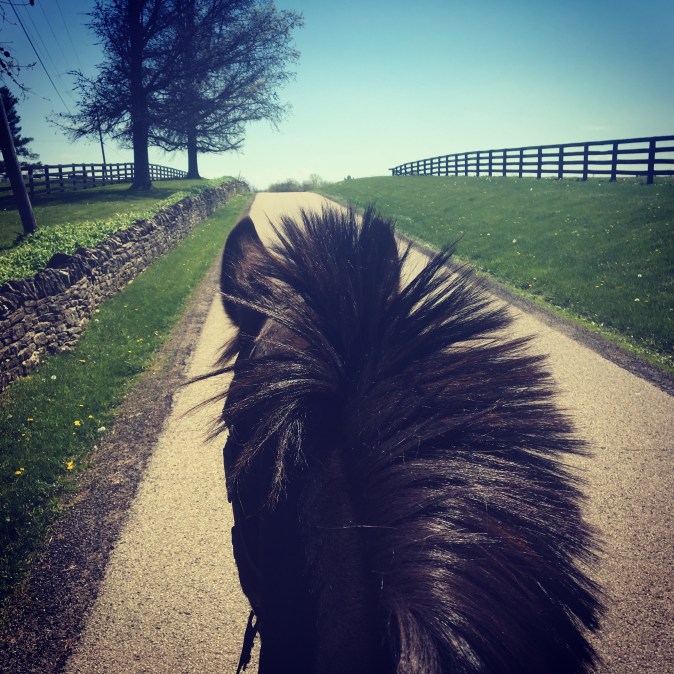
So, uncertain of my future and how to fix my issues, I resolutely began just hacking again. Playing with bits, playing with tools that I knew I had in my repertoire. I reread the story on ESPN that I come back to constantly, and remembered what had gotten this horses brain to come as far as it had come – meandering. So trail ride we did.
But then Wednesday night I was contacted by a girl who I used to board with – Daina Kaugars. She asked if I would be willing to fill a spot in her upcoming clinic with the one and only Sinead Halpin – a rider that I have always looked up to and respect immensely. I stared at my bank account, juggled integers in my mind as I tried to figure out if I just scrapped the next show I wanted to do, and maybe didn’t eat any protein for the next two months, I could possibly, probably, maybe afford to clinic.
So I signed up, said a prayer to the Horse God’s that she was as good a clinician as she was a rider, and penciled it in for Sunday at 8am. I got placed in the novice group – because, ya know, thats what most people do after getting eliminated at beginner novice.
I showed up on Sunday with a churning stomach and trembling hands. I introduced Sinead to Nixon, letting her know of our previous issues – primarily that he switches from chicken shit to freight train with a flip of a quick switch, and that I am usually under-prepared for that moment.
We started very small with a placement pole 4 strides into a bounce pole to a double crossrail, and I forced myself to do something that I have never done before – I asked Sinead to drop the second crossrail and let me just pop over one the first time. I told her that I had promised Nixon after one particularly bad warm up that I would become not just his rider – but his advocate. There are many better riders than me, and certainly better horse trainers, but no one knows the inner workings of my horses brain like I do. I knew that seeing a strange cross rail oxer as his first fence- something he had never seen before – would not only perplex him, but possibly effect the rest of our ride. But I was pleased to see that Sinead was happy to do exactly that, and we were able to begin our ride with a good start and a happy horse.
The exercise grew higher and higher, with Nixon stepping up to the plate each time, amounting in us jumping the largest fence he has ever seen.
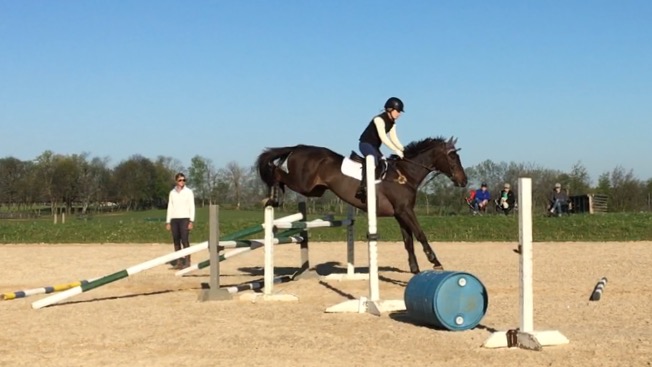
Sinead looking on as we popped over a large over
Sinead commented on my crumpled left side, and my overreaction over fences – and I just had to laugh, acknowledging that I had been struggling with these two feats for probably 20 years. But she gave constructive criticism for each, and I felt myself stretching my right side and sitting a bit higher as the lesson went on. And as she taught, I happily realized that my horse had showed up on this particular day, allowing me to work on myself, and not just him.
As we moved onto coursework, Nixon became more looky, stopping at a crossrail after having popped over a 3’3 oxer like it was nothing. The perfectionist in me cringed, but the consummate student was pleased to find Sinead unphased, and the fellow riders and auditors supportive. Nixon eventually reactivated his brain, shockingly at the same time that I renewed my rider’s card, and we eventually popped over the coursework in sync. A feat that I was quite thrilled with – seemingly fitting in with the other novice horses on my sweet baby of a horse.
And as I walked back to my trailer, I acknowledged that the lesson hadn’t gone perfectly – but was that the goal? We ride with these greats in order to fix our issues, not to brag on our accomplishments. Had Nixon been foot perfect the entire time, the money that I had scrounged up and the Ramen that I had purchased for the next two weeks would have been for nothing. Instead, he and I both showed our insecurities and issues, and Sinead walked us through with strategies, exercises, and training tools to better them. And at the end of the 90 minutes, we weren’t perfect – but we were better.
More importantly, I walked away with a smile. Daina of DK Equine organized a beautiful clinic – with the key word being organized. It ran smoothly, it was on time, and the setting of Antebellum Farm was beautiful. The riders were kept informed throughout the process, and it was a stress-free and encouraging environment.
And I realize that the money I spent will not help my record immediately. I didn’t win a $3 ribbon or earn a snazzy trophy. But I have now realized that for me, I don’t seem to crave the same end goals as others. Do I want to move up the levels? Sure. But schooling those levels is just as fun as competing at them.
But indirectly, this money is so well spent. For each singular effective lesson will impact hundreds of events down the road. Each exercise building on the very ground in which we lay our training. And each training ride either improving or hindering our minds and bodies at the competitions. For if I have learned anything, it is that practice doesn’t make perfect – practice makes permanent.
So lets ride with the best, learn from the greats. Make permanent the good skills and remove the bad habits. Absorb every ounce of knowledge that we can. Because, the most important thing that I have learned is not the ability to win – but the ability to improve. To become the best rider I can be. I hope that this lesson got me one step closer to that – and to be honest, I think it did.

Big pats for a good ride
What makes you happy? Is it a long walk with your dog at the end of a hard day? Is it cooking dinner for your loved ones while enjoying a glass of wine? Or is it getting covered in horse hair, climbing into your truck, and driving home while singing Sam Hunt at the top on your lungs – your muscles tired and pulling.
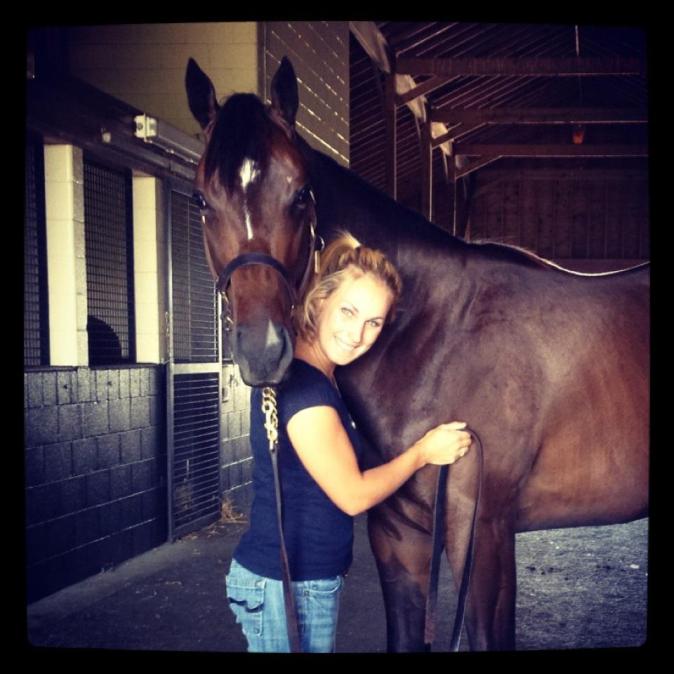
The third option is mine. I do not know how to exist in a world without that option. I do not know how to function without my face covered in dirt and my quad’s screaming in agony. To have horse hair covering my breeches, and manure embedded under my nails. But what some find as just simple happiness, I think might be my addiction.
After this weekend, one in which I added a big fat E to my record at the first event of the year, I turned to my boyfriend and said that maybe I should sell both of my horses and take a break. Go cold turkey. I didn’t really like showing. And in addition to this, I couldn’t afford to do it often enough to get over my nerves. He turned to me and laughed, saying that I would survive for two days before bouncing off the walls. I would need horse rehab.
A boyfriend who is understanding of ones addiction is essential.
Because I am the opposite of a weekend warrior. I am a day-in and day-out, withdrawals after a day, Christmas Day and New Years Eve, kind of rider. I am the three horses a day, go to the barn in the dusk, ride in the snow kind of girl. I am the nausea-ridden, hacking up a lung, blood coming out of my body, but still checking limbs and shoes kind of horse owner.
I wouldn’t do well without this. I gave both of my big boys off this past Monday due to a hard weekend, and was bouncing off of my couch by 6 pm – badly enough that my boyfriend demanded I go hop on my retired quarter horse Frank. I knocked off the mud, swung on bareback, and trotted around our yard just long enough to get my cravings out. To recalibrate my system. To feel the nerves relax and the synapses quiet. I got my fix.

But what makes this addiction ok, and an addiction to a substance not? Some are addicted to drugs, others to alcohol, many to sex – and I can relate to all of those. I have an addicts personality. I have zero will power against the cravings. I fixate on finding a way to that high. I guess the only difference is that my addiction is considered culturally ok. Societally acceptable. Just as dangerous, and just as expensive – but Prince Harry does it – so we’re good.
And probably the scariest part of this addiction is that there is no such thing as horse rehab. No one to tell me that I am not normal. Like a true addict, I surround myself with other addicts. People who tell me that it is OK to wake up at 5am to get my fix, people who tell me that it is OK to spend their every cent on this high, people who tell me that my friends and family just don’t “get it” when I miss weddings and birthdays.
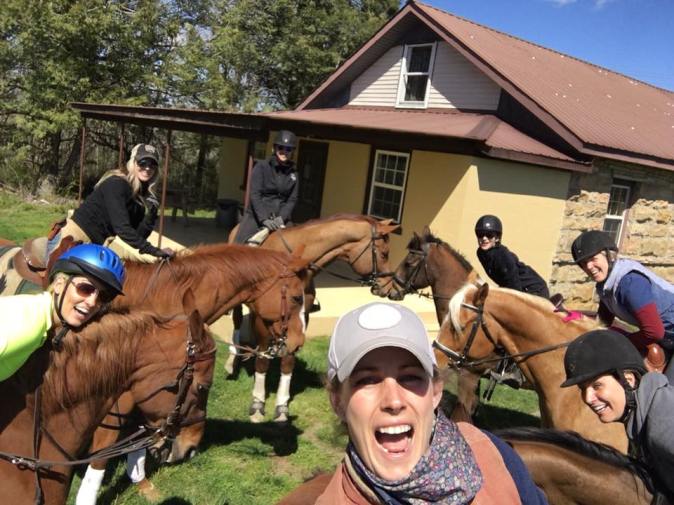
These people think my behavior is normal.
I asked my boyfriend the other day if he thought he had hit the jackpot when we started dating six years ago. I was a horse girl without the horse. Someone who could appreciate the races, talk the talk, hold a yearling, but who’s life could be…normal. He didn’t even hesitate before saying “Yes.”
But just like my boyfriend measured his smoking addiction on packs a day – I now measure mine by horses. Six years ago, I was just a social rider. Just like those people that smoke when they drink – I would hack on the weekends, playing around with the idea of the abuse. And this trickled into a daily thing. Not extreme, but I borrowed someone else’s substance (horse), and began competing again. Rode every day – but I hadn’t jumped in with both feet. But then I got my own. Like the person that suddenly realizes that the high is the first thing they think of when they wake. I bought Mak, and began to fixate on the high. All day at school. Speeding to the barn as the last class let out – needing that fix.
Rain or shine…
And it’s only gotten worse. I went from one horse, to two, to three, with one back up – so four. I am frantic in my grooming, craving the ride. I am only content when I am on. My days are spent fidgeting and focused on that trot set, or that jump school. I am distracted in class, pulling up Youtube videos of prior tests, or searching the web for my next show. I am officially, and utterly, hooked.
So if the first step to recovery is admitting you have a problem, then I am there. I’m sure that there are meetings intended for people like me – that is why we made 4-H and Pony Club, right? Only, unlike the others – these are more of a support group than a rehabilitation center. A grief support system that drinks wine and stares at our empty bank accounts together. A Rider’s Anonymous meeting that speaks of the things that we gave up in exchange for our fix – family, friends, relationships lost. We nod our heads at others that we know suffer from the affliction when we pass them in the aisles of grocery stores – reaching for the carrots instead of the kale.
So lets just start here: My name is Carleigh Fedorka, and I am addicted to horses. My blog’s are my stories, my stand in front of the group. Let this be my Rider’s Anonymous. I have a problem, an addiction to dander and dust, mud and muck, thrills and spills, and I love every single minute of it. And I hope, for your heart and your soul, that you do too.
I walked off of the cross country course yesterday with my head hanging low and my reins swinging on my horses neck. Having never even broken a sweat, Nixon strode out strongly, not comprehending that I was upset. In his mind, he had done fine. He had jumped all of the jumps – just not on the first try. He had galloped out strongly, just as his trainers had taught him for 4 years. And he had come back to a walk when asked.

In his mind – he had done well.
But in my mind, I knew that I had been eliminated for the first time in over a decade. I was reeling. Angry at myself for not riding better, not training better, not having picked an easier horse. Having flashbacks to exactly this walk as a teenager – acknowledging that going from first to last in an event is a skill that maybe only I know best.
I got back to the trailer, untacked, patted Nixon on the neck, and let him nuzzle my arm – glaring at him, but not physically shoving him away. I got him loaded and home, and swung on my other horse for a spirit-lifting ride.
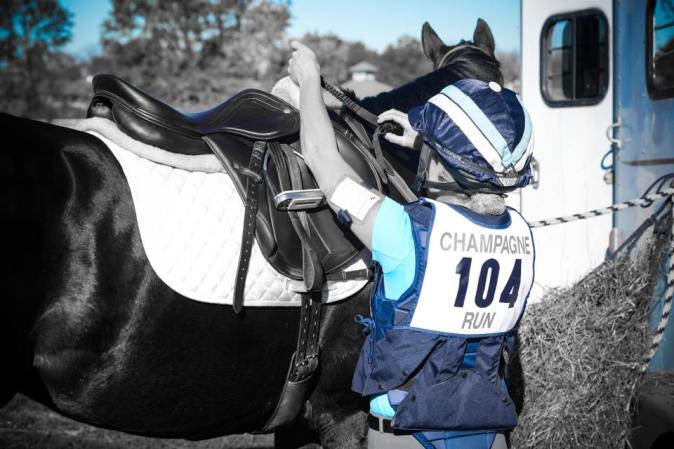
And then my phone beeped. Again and again. And I picked it up to see that a horse had died on course. My heart stopped, and I sent up a quick prayer to the Horse God’s, asking them to support and protect this family and their friends. I turned back to the barn and hugged Nixon hard – realizing that although I though I had hit the lowest of low, my horse was standing sound in his stall, and we would have another chance at this game. And then I prepared myself for the press release…and the comments.
I knew that the comments under Eventing Nation would be ok, and the comments under USEA would most likely be as well. But I acknowledged that the minute that Chronicle of the Horse, or Horse Collaborative posted this story – of a horse collapsing while running training level, that the negative comments about eventing would pour out. It’s the same when a racehorse breaks down. And for some reason, I have chosen to love both of those dangerous sports.
And each time a horse breaks down, or has an aneurysm, or collapses due to a cardiac infarction, the masses come out to do nothing but rage against the sport. They give no heed to the family that is reeling, or the teenager that is suffering. They give no heed to the horse that is gone – even if they claim they do in their keystrokes. But they never do in their actions.
Because 98% one of those pleas for change, or action, or a difference are empty. How do I know this? Because in addition to being an event rider, and a racing supporter, I am also an equine researcher. I am only a few months away from finishing my doctorate in Veterinary Sciences, with a focus on Equine Reproductive Physiology. And I know what it is like to have a great idea that will better equine welfare, and the animals to do the study, and come up empty. Simply because none of these people who demand science are willing to put money where their mouth is. They want to cause an uprising in these worlds – but with no science or data to actually back up their words.
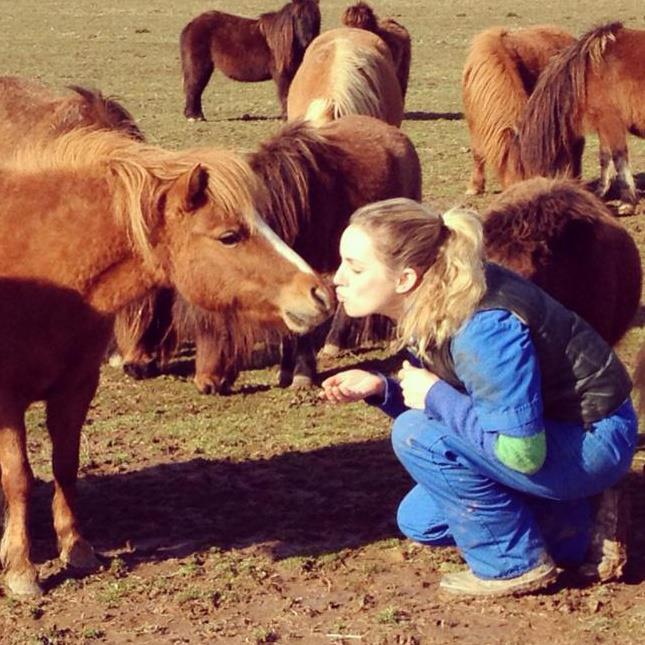
Have you hugged an equine researcher today?
Are horses bred weaker? Can heart defects be detected well in advance of competition? Will giving a horse acepromazine before competition weaken its muscles and cause potential life-threatening complications? Does competing in the heat cause an increased risk of aneurysm? Are we pushing these horses joints past their limits? Do frangible pins actually decrease the risk of rotational falls?
It’s easy to say yes to all of these things. It’s easy to make a correlation without actually proving causation. It’s easier to sit behind a keyboard and admonish everyone who is out there every weekend. It’s easier to judge the poor soul’s who somehow find themselves on the receiving end of these awful and hateful comments, with no reason to be the center of the attention besides simple bad luck.
But you know what would be the easiest? To take the same amount of time to write that nasty comment, the one that does absolutely nothing besides cause further grief in the 16 year old competitor who has to read it after losing his horse, and put your money where your mouth is. To the Grayson-Jockey Club Research Foundation. To Morris Animal Foundation. To the United States Eventing Association’s Research Group. To a local research group, just like the one that I have been lucky enough to do my doctoral research at, the world-renowned University of Kentucky Gluck Equine Research Center.
Organizations like this fund the researchers that crave to answer these questions. The brightest of the bright who have the animals, the laboratories, and the knowledge to actually provide answers. These same minds who created the vaccines that we use, who invented the ultrasound, who discovered the very ointments and therapeutics that we use on a daily basis. We have trusted them with so much in the past – why no let them do their jobs now? Get out from behind the keyboard, and get in front of the game.
It will only be when this change happens that we will truly be able to enhance this sport. To take the highest level of care of these animals that we love so much. To make this world the safest possible. Be the change you want to see in this world. Go from cyber bully to cyber supporter. And more importantly, get off of your computer and go to the barn. Hug your pony. Hug your trainer. Hug your barnmates. And hug your loved ones.
Because life is short, the strides are long, winding, and yielding. But this ride – this ride is always good.
Yesterday was, to many of us, the first show of our season here in Kentucky. It was the Paul Frazer Memorial Combined Test at the Kentucky Horse Park. A show that has become a staple to many of us eventers, it is a great way to dust off the cobwebs without adding a recognized score to your record. With a real show vibe but a schooling show name, it is the best of the best, and has become a favorite of mine over the years in which I have gotten back into the game.
A week ago, and with a late fee, I hesitantly signed up both of my boys for their debut’s into 2016. For Mak, it would be his first show since his training level move up. As many of you know, we had x-rayed his leg following this event and had found his splint bone in 4 pieces. Requiring surgery and 6 weeks of time off in the middle of show season had effectively shattered our plans for 2015, and right when I was getting him legged back up, the eventing season in Kentucky was waning down. The winter was long, and the arena was frozen. I have gotten the chance to jump him probably 3 times since November, and decided to enter him in Novice instead of Training. I wanted it to be a confidence building, not confidence proving experience; knowing that I have nothing to prove with this horse.
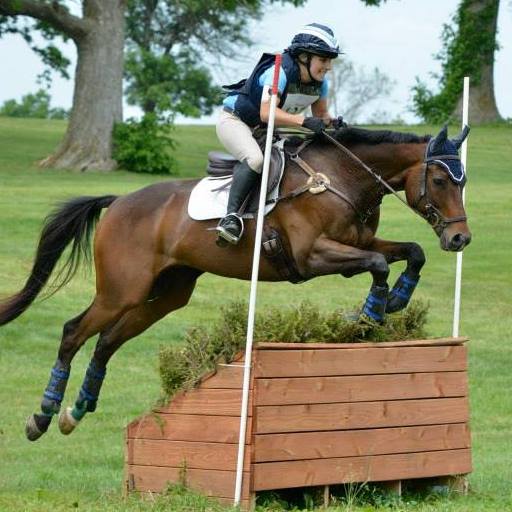
My last show with Mak, almost a year ago
Nixon is different. I have gotten to jump Nixon on and off this winter, as I have kept him in full work, and if there was ever a day (this happened often) where time or weather forced me to pick one horse, he drew the short stick. But Nixon is green. And I am only an amateur. I’m sure many others would have entered him in Novice as well, acknowledging that he can step over 3′, but I am not others. So I chickened out, and I entered him in Starter and Beginner Novice.
Because so many people seem to forget that just 5 years ago, I was going to these shows simply as a groom for my friend. Dog attached by a leash, with a camera around my neck, I went to scream and cheer, and nothing else. I had jumped a horse once since turning 19, and spent the majority of my time in the saddle with a rope in my hand, not a crop. And I hadn’t shown for years. Why? Because of something that I am slowly realizing…again…I hate showing.
I tried to explain this to my boyfriend yesterday as we sat at the trailer and I screamed well wishes to everyone who rode by. He laughed at me and said
If I’m the mayor of Paris, Kentucky, then you’re the mayor of the Kentucky Horse Park.
He had grown up in the hunter world, and this overzealous happiness and camaraderie was new to him. He kept asking me if I knew the people that I was calling out to, and I giggled and admitted that I knew only half. But that this is a part, one of the only parts, of showing that I actually enjoy.
I love that in eventing, I get to see some people that I rarely get to see otherwise. I love hacking to the dressage complex and having people cross your path and wish you good luck. I love warming up for stadium and knocking a rail, having it quickly replaced by a trainer that you are competing against. And I love galloping over a fence and hearing my friends, family, and photographers scream me on.
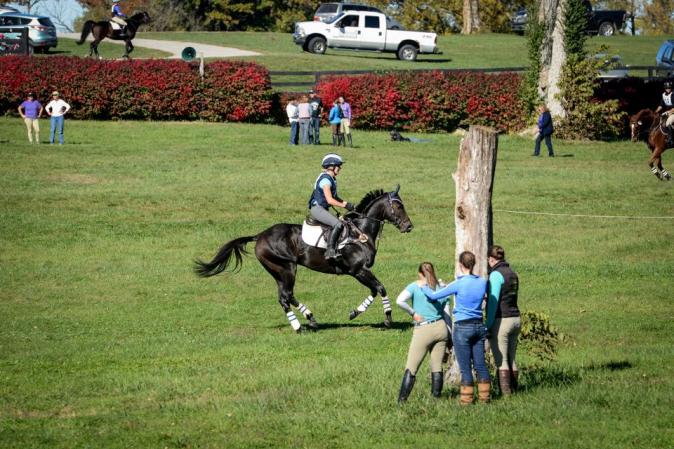
But I hate so much more. I hate the nausea that I feel in the days leading up to the day of the show. I hate the restlessness that I feel as I braid my horses. I hate the pressure that I feel from others when they ask if I have entered, or how it went. With Mak, so much of this is erased – as the only rat race that I am chasing is my own. He has never been for sale, and therefore the pressure has been off. I have never entered him at a level that I feel unprepared for, in fact, my most timid of friends were actually pushing me to move up to Training level, saying that he of all horses was 100% ready. So with Mak, my goals are simple. I want an obedient dressage test and willing jump rounds. Nothing less, but I also don’t usually desire much more.
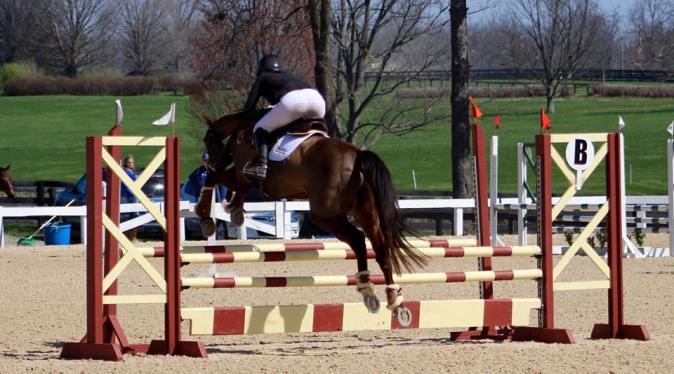
An obedient stadium round
But Nixon is different. Nixon has a following. I take 75% of the blame for this, due to my blogging and his Facebook page. I never knew of the freak that he would become when I started this. In fact, I had just wanted to use those platforms to describe the struggles and issues that come along with retraining an ex-racehorse of his caliber. But instead, he proved me and the world wrong, and became the rockstar that he is today.
…Nixon win’s things.
And because of that, the pressure is on. I have opened up my life to the masses, and then when I get to the shows, I panic when those masses approach me. If he doesn’t have a perfect dressage test, I feel judged. If he has a stop in stadium, I feel judged. If he doesn’t load on the trailer, I feel judged. And all of that pressure lying on an adult amateurs shoulders, an adult amateur who just got back into showing a few years ago, is heavy.
But whereas the rest of the world is waiting to see if I win, or if I lose, I have my own goals with Nixon, just as I do with Mak. I prepare for the shows not concerned with the color of a ribbon. My goals with Nixon are much simpler than many would expect: I just want to finish.
I wanted him to jump around stadium in a conversation with me. I wanted him to stay steady and unphased in a hectic dressage warm up. And I wanted him to be stronger. I didn’t want the same comments to be read on our test. I wanted improvement. Growth.
Yesterday, I trotted into stadium in an almost daze, because I had previously owned an amazing dressage horse, Levi. I knew what it felt like to be winning after dressage and still find yourself at the bottom of the board after a jump phase. I had been there. And my biggest fear was that I was sitting on another. The jumps were only 2’3, and yet as I waited for the bell, my hands were literally trembling.

Petrified of stadium
But I tried to shut out the spectators, ignore the muscles spasming in my body, and focus on the horse underneath me. Remember my goals. Find the finish line. And remember that it was Nixon beneath me. This rebel without a cause who I had fallen so in love with. This Ferrari with unlimited gears. This (not-so) gentle giant who had seemingly picked me as his person. And I urged him into a canter and aimed him at his first fence in the big ring.
He eyed it, hesitated, and then seemingly asked me “Ya, Mom? We get to jump now?” and then fired away. Fence after fence, he got happier and happier. He only had one baby stop in either of his two rounds, entirely due to pilot error and a lack of comprehension of which fence we were aimed at.
We won. Again. Nixon left the show with a 20.6 in his Starter dressage test and a 26.6 in his Beginner Novice. He added one stop to his Starter score, and nothing to his Beginner Novice. He won both divisions and had the lowest dressage score of the day, out of hundreds of competitors.
And I smiled. Only my smile had nothing to do with my dressage score, or my blue ribbon. It had everything to do with my own personal goals. The goals that I had accomplished.
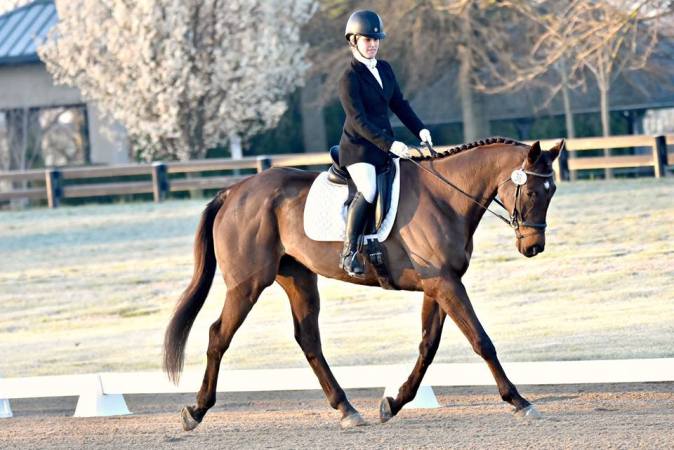
One of my goals: Not having him behind the vertical. SUCCESS. Photo by JJ Silliman
Nixon had warmed up in one of the most busy dressage warm ups I had ever seen as a grown man. Instead of blowing and attacking horses as they bumped him, he canter half passed away. He stood patiently while his brother was ridden, even if his brother didn’t handle the separation anxiety quite as well (damn you, Mak.) He loaded to the show, and back to home, like a champ. He warmed up for stadium like a seasoned professional. And then he went into a very large and intimidating stadium ring and put it all on the table.
A friend of mine messaged me yesterday and told me that she overheard fellow competitors checking their scores and one of them asked who won the BN division and her friend said my name. The girl responded “Of course she did.”
And when I read that, I laughed. If my name has become synonymous with winning, then it just shows how quickly your reputation can change. I haven’t won anything of significance in years. Mak has always been a solid citizen, but never in the top 3. My babies have always been exactly that, just babies. And even years ago, my childhood horse had more E’s than $3 ribbons.
This change in reputation proves that just like the mighty can fall, so can the little person rise. Nixon has obviously come into my life for a reason – and maybe a part of it is this. To teach me that with patience, time, hard work, and intelligent decisions a horse can change. To show me what a horse of this caliber feels like, and be blessed with the ability to ride him every day. To prove to everyone that a free horse can be the most valuable creature in your barn. And I guess he taught me how to win. He’s giving me a name.
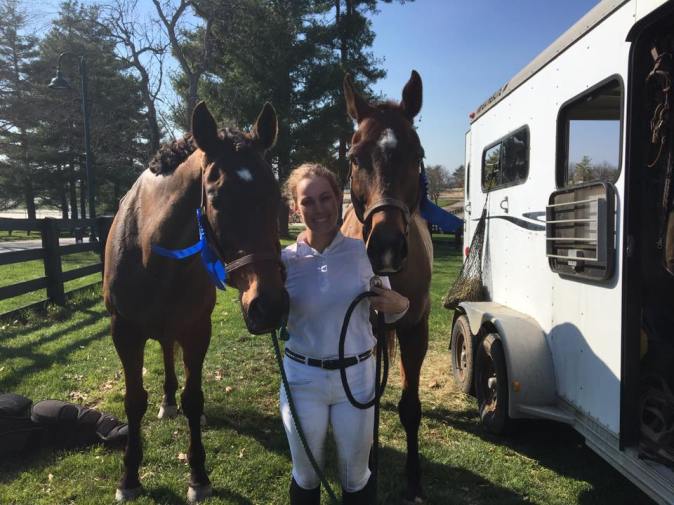
Nixon shared his blue ribbon’s with his brother Mak
But more importantly, he is still teaching me how to handle the pressure of being a winner. To deal with both the haters and the fans. To control the anxiety and the nerves. To live with the constant questioning of your skills and the control over your every move. And more importantly, to not let these things deter me from showing.
And although I am learning these skills, one show at a time, I am still just me. The girl who screams at random people as they hack to their ride. The person who gives her ribbon away to the little girl standing next to her at the window. The woman who is never happy with herself, and shakes her head at 1 time fault. The cowgirl who stares longingly at her Billy Cook every time she reaches for her Amerigo. The girl who loves both of her horses equally, even if one of them won two divisions, and the other didn’t get a ribbon.
You know why? Because they both exceeded my expectations in my personal goals. They both rose to the challenge that I placed in front of them, and carried me and my bum arm around a long day. Nixon might have walked away with 2 blue ribbons, but Mak walked away with a lot of confidence, and made me remember why he is my keeper after all. Because, most importantly, what everyone needs to realize, is that it’s not beating other people that matters. At least not to me. Whats truly important is beating your own goals.
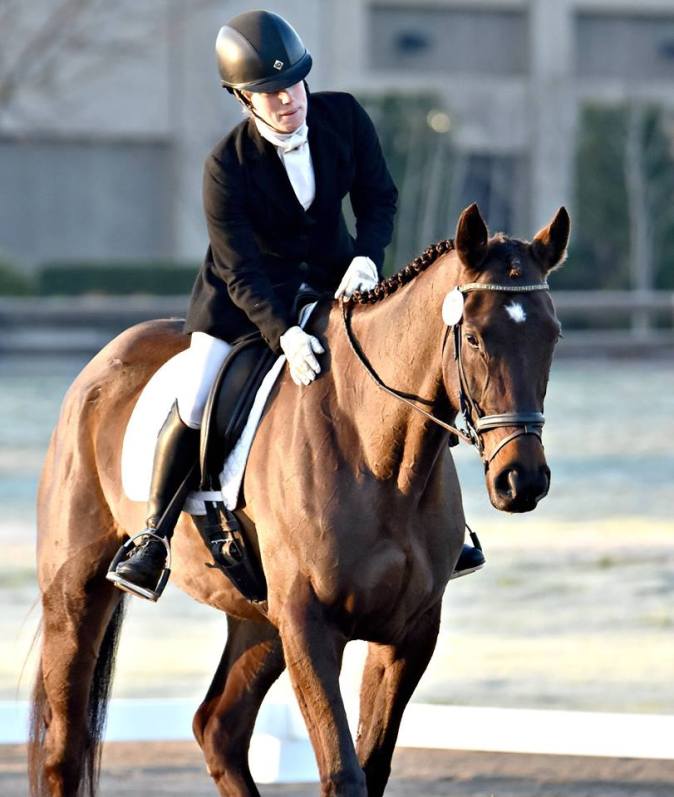
Photo by JJ Silliman
So yesterday, on two horses, I won. On both. I accomplished every personal goal, and more importantly, I left the show craving more. One horse might have walked away with two blue ribbons, but both horses won me over. My goals became victories, and my expectations became reassessed. And that is the most important thing. I hope you accomplished yours too.
I have thought long and hard about writing a blog like this. How do I write about being criticized without sounding above someone? How do I write about my fear of rejection without sounding bitter? And how do I write about my own personal insecurities without making others feel bad for taking a stand for their own beliefs? I don’t know. But I will try.
This blog started as a way for me to write creatively while I pursued my doctorate in a science field. I never knew that I was a good writer until it took off and other media sources asked to publish it. To see my words in magazines that I have purchased since I was a little girl – like Horse Illustrated and Chronicle of the Horse, has been surreal. To read the supportive comments on websites like The Paulick Report, a news source that I read diligently as a member of the thoroughbred industry, has been so affirming. And yet, underneath all of my posts, there will be at least one rude comment. One naysayer. One Negative Nancy.
Last week I was told that someone thought that my blog was anti-racing, and that it was offensive for me to track down the horses that I assisted in breeding and raising and encourage their retirement. I was told that because I pushed for second careers that I didn’t respect their first. And I broke down. In front of both close friends and my boyfriend. I questioned my integrity, I questioned my path, and mostly, I questioned my writing.
My boyfriend reasoned with me in the most simplistic way. He told me that if I was going to put myself out there, and let others be a part of my life and this world, then I would have to develop thicker skin. He has told me numerous times now that he doesn’t understand how I can expose myself so intensely. I have reasoned with him that as long as it is something that I stand by 100%, as long as I know that I can back it up with science, or citations, or experience, I am willing to stick my neck out. To take the hits. To be the poster child. He responds by telling me that he supports that, but that I then need to stop reading the comments, or responding to the negative. To be stronger and more secure.
But I’m not there yet. I am still insecure and weak. I have moments where I think that I am doing so well with this blog. This thing that has spread farther than I ever thought it would. This platform that I have created unintentionally. I never wanted to be the voice of the off-track thoroughbred, or the insider to the thoroughbred breeding industry. I just wanted to write. To tell my stories. The same way I would over a beer with friends.
There are days where I pause my pointer over the delete button on this blog. Where I don’t understand why I willingly stick my neck out, ready for the guillotine. Why I answer the phone calls of the bitter old men, who only wish to tell me how naive I am. Why I click on the comments telling me that I am wrong.
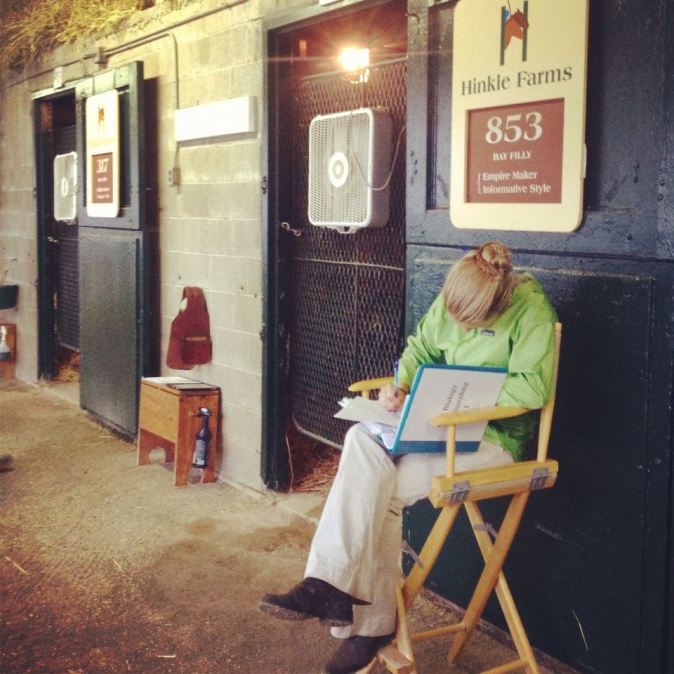
Cyber bullying is real. And there seems to be some statistical correlation between extreme cyber bullying and horse people. I have now watched it happen to the youth of our industry, as well as the adults. And I see so many telling the teenagers that it will get better, that this is just a phase. But it’s not. The negativity will always be there. The comments will always come. And the more publicly you live, the more exposed you are, whether it be by fame or fortune, promotions or pictures, the more negativity you will encounter.
So how do you counter that? I wish I had an easy fix. I am 30 years old and still feeling insecure in my own place. I still contemplate throwing it all away, and wanting to crawl back into my unknown hole. I yearn for the days when I would show up to a horse show and happily sit in my lawn chair, drink a beer, and stare at my pony in blissful ignorance and peace.
But every time that I pause over that delete button, I stop. Why? Maybe, just maybe, because I am stronger than even I give myself credit for. Because I don’t know of many others who are willing to stick their neck out for the things that they believe so passionately about. And I take a moment to reflect and recognize the small amounts of good I have done. That person who told me that they had believe what Last Chance Corral wrote about nurse mares until they read my blog. Or the person who said that they didn’t know that the thoroughbred farms actually claimed their homebred back. Or even the person who said they signed up as a bone marrow donor because of my blog.
Those three people, to me, offset the woman who thinks I am anti-racing. Or the blogger who says that I am lacking real understanding of what I write. Or the man who hunted down my phone number just to tell me that a national governing body in racing would kill us.
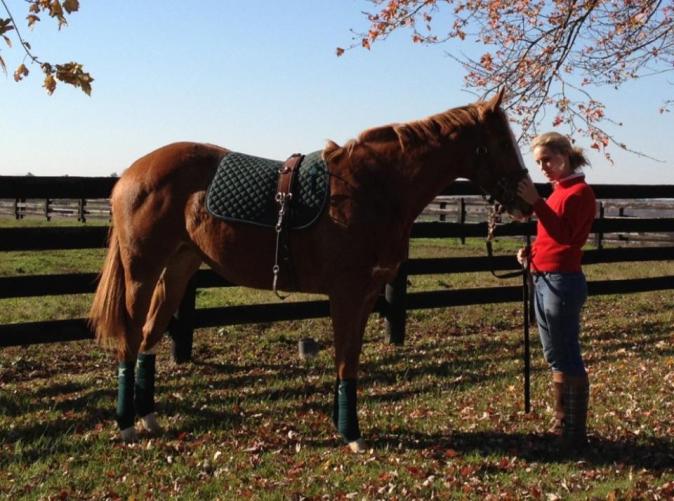
So I guess I’ll keep writing. I’ll try to develop thicker skin. I’ll keep sticking my neck out. And I’ll try to use the negativity to make me a better blogger. If you think I’m anti-racing, I obviously didn’t write clearly or concisely enough. If you think I don’t understand how to retrain an ex-racehorse, I will spell it out more simply. And if you think that I don’t promote the thoroughbreds first career, I will make it more obvious.
But mostly, I will keep on doing what I’m doing. Because I believe in it. I love doing it – the actual writing aspect. And it seems like few else are willing to. I will keep on trucking along, one post at a time. This blog was started for the most simplistic reason – a love of writing. And it carried on into something much bigger than I could have ever dreamed. If at the core it remains the original goal of allowing me to utilize the passion of pen, that will be enough. If in addition to that it brings awareness to two platforms that I would take a bullet for – horse racing and cancer, then it was worth the insecurity.
I will continue to write. I will also continue to thank the thousands of you who read this blog, day in and day out, and support me with encouragement and kind comments. The ones who share it and support it, getting the message spread even farther.
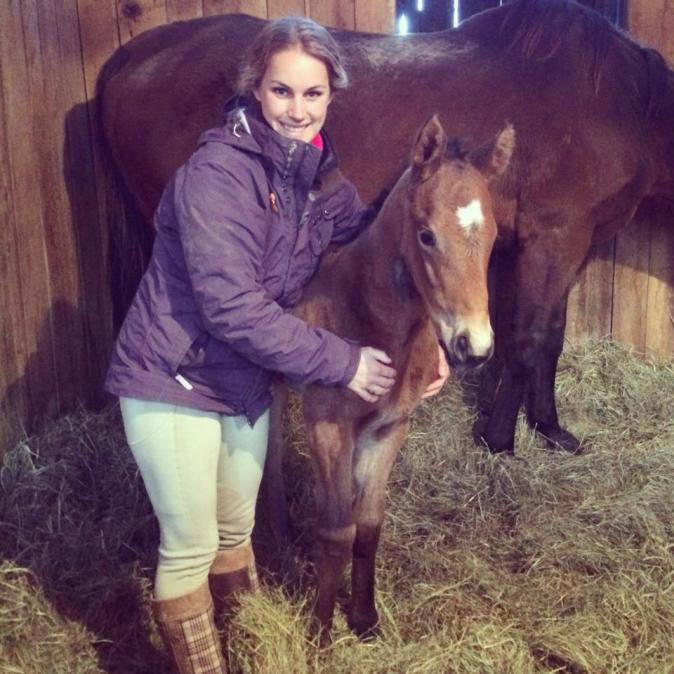
Thank you from me and baby Bode
It means more than you know.
XOXO,
Carleigh
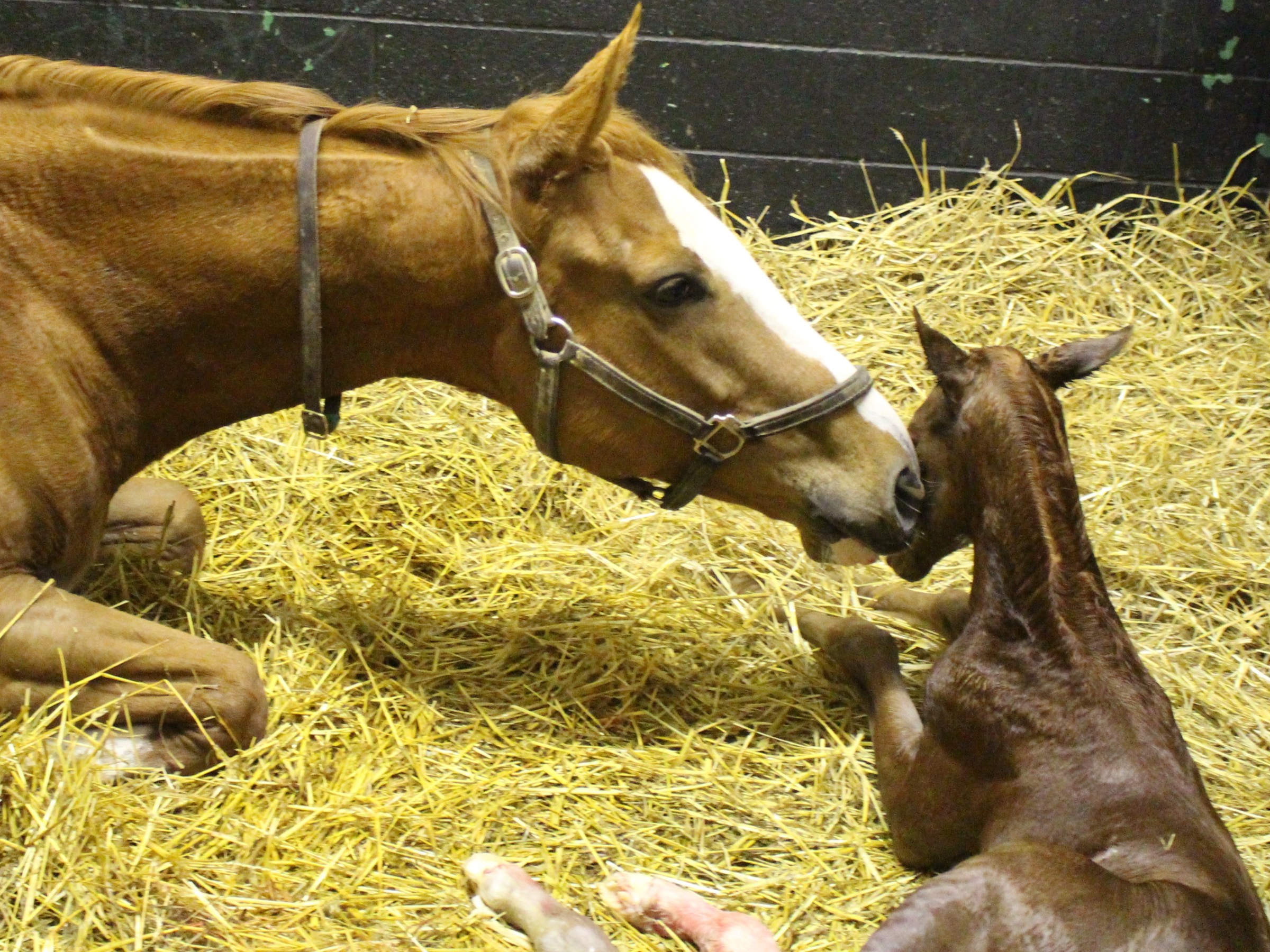
I got to win the horse lottery last night. Beat that 1 in a million odd. Because if there’s any absolute truth in this world, it is that owning and raising horses is full of up’s and down’s, with the down’s heavily out weighing the up’s. And it’s rare enough to watch a horse come full circle in the most normal of situations. It’s even rarer when you get to be a part of every single major moment of that horses life. But the rarest of all is when you’re told that a horse most likely won’t survive, that it doesn’t have a good chance at life, and you work day-in and day-out to fight those odds. And you win.
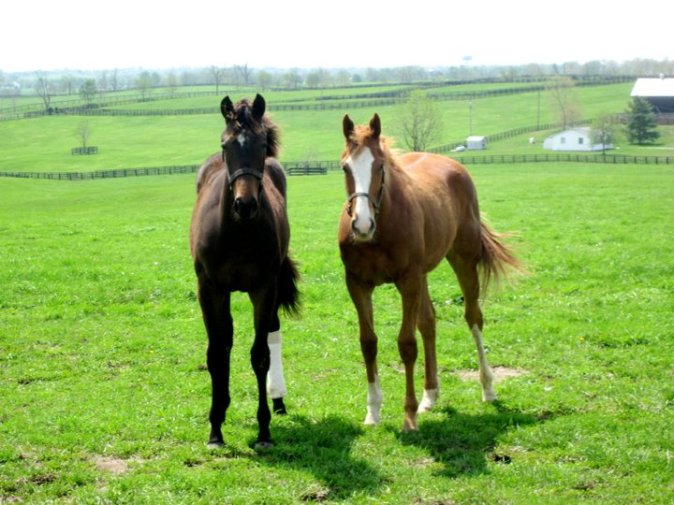
Healthy yearlings
I finally got to experience the rarest of rare. I won the lottery.
Hit Girl is one of “mine”. In the horse business, “one of mine” rarely means actual ownership. It usually means a yearling that I prepped for the sale, or a foal that I delivered and raised until it was weaned. For those of us on the farm, we will rarely get to own these majestic creatures-but they are ours nonetheless. We know their ins and outs, the whorls that line their heads, and the quirks that complicate their days. We know which one hates pellets, which one doesn’t like its left hock being touched, and which one likes a snaffle more than a chain. They are all treated with love and respect, but each is unique. And some are just different. Some stand out. All are “ours”, but few are truly special.
Hit Girl was one of those. She was, and is, special. At least to her breeders, and now owners. And to me. She might not be Rachel Alexandra, or Zenyatta. She might not have a Facebook page with 10,000 likes. She never won a stakes race, and her name won’t adorn a street sign in Lexington. But to me, she is special. I was there when she was born, I was there when she took her first gallop around a paddock, and I was there when the surgeons told us that she probably wouldn’t make it.
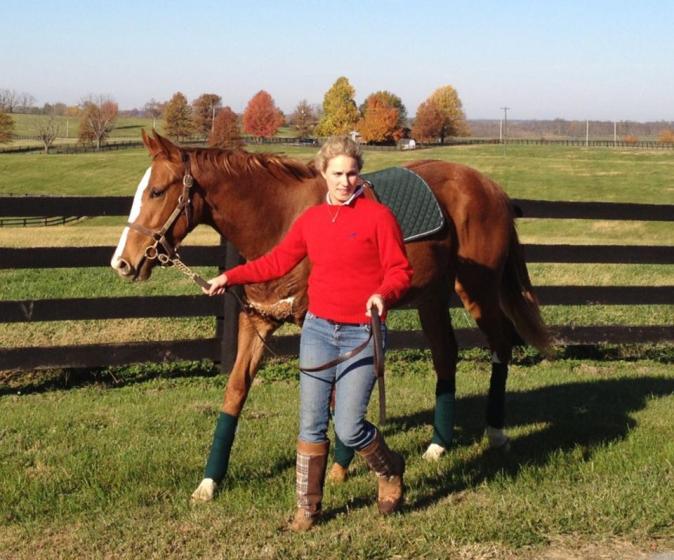
There for her training
As so many horses do, with no negligence from any humans part, Hit Girl got hurt. To this day we do not know what exactly happened. Some of us think she tripped and fell. Some of us think she got cast in a paddock fence. Others think that she was kicked by a pasture mate. But what we all can agree on, is that she had the largest hematoma that we had ever seen. At its largest, it went from mid neck to mid barrel, and shoulder point to shoulder point. We estimated that it contained 50-75 pounds of blood. Numerous surgeons came and they all said the same thing. Leave it alone. It is still growing. The blood source has not shut off. If we lance it, she will probably die.
I would stare at them with dismay and ask “but what about when it opens on its own?” They all just grimaced.
But it did open on its own, and she did live.
Through the use of both allopathic and homeopathic medicine, amazing veterinarians, and a superb farm staff, she survived. It took moments of ingenuity, moments of bravery, moments of terror, and moments of extreme heart. The same heart that dictated the rest of Hit Girl’s life.
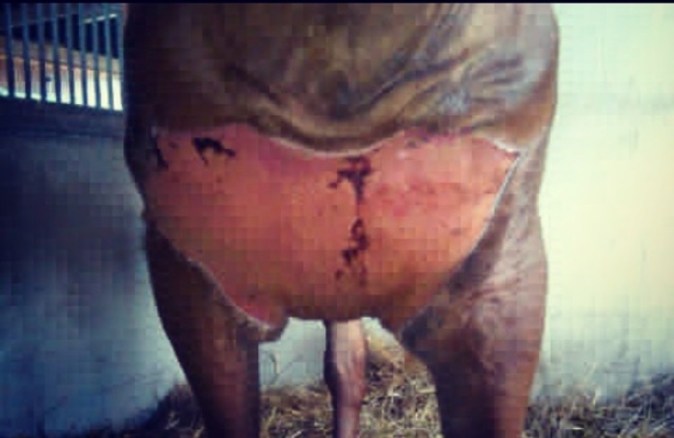
Hit Girl’s chest after three months of healing.
I was told quite a few times throughout the recovery that it might not end well. That although we might have gotten over the hardest part, the outcome still wasn’t great. That there was still an extreme risk of infection. That she most likely would never be ridden, and that she probably would never race. We would be lucky if she was just pasture sound. We would be luckier if she could carry a foal.
But Hit Girl had other ideas. She checked off each of those boxes as if it was her personal Bucket List. Broke – check. Race – check. Win – check. And she did more than just win, she won at one of the most esteemed tracks in the nation, Keeneland. Twice – check, check. She traveled the country, running both on the East Coast and the West. She got claimed from her breeder, but he fought back. I thought I had lost her during that time, but was yet again amazed at the heart of this race industry when I reached out to her new connections. They loved hearing of her story, and treated me as if I was a partner. But still, nothing made me happier than getting the phone call from Anne Archer Hinkle letting me know they got her back.
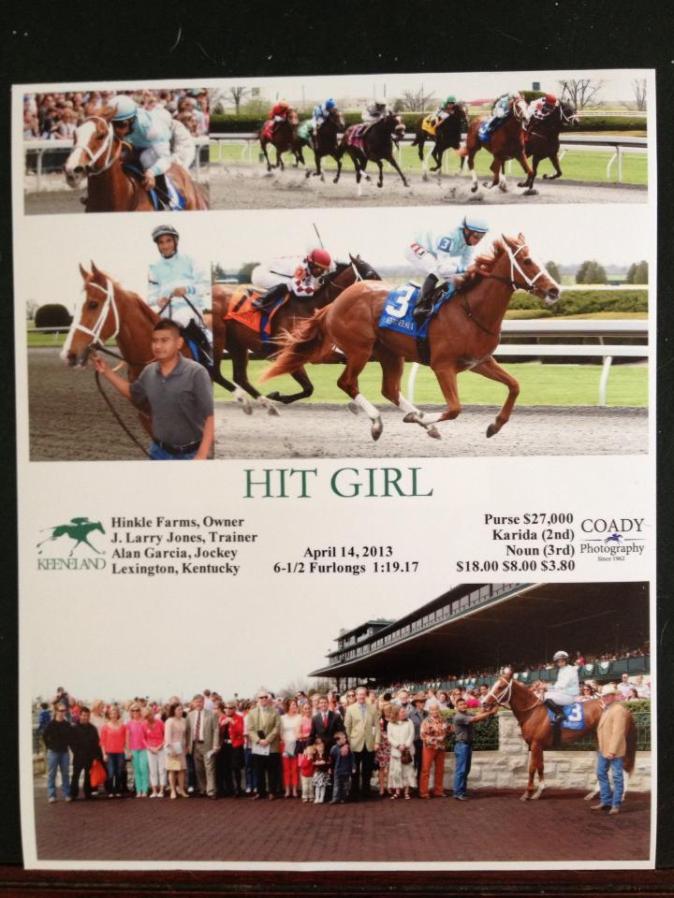
Winning at Keeneland
Being a part of the Hinkle family has been on of the best experiences of my life. I was just one of their managers. I only worked there for a few years. But to this day, they treat me as part of their team. So with every special moment in Hit Girls life, my phone would ring. Letting me know they had chosen a stallion, letting me know that she was ready to breed. Informing me that she was in fact pregnant, and then last but not least, letting me know last night that she was ready to foal.
I flew to the farm anxious to see what her foal would be like. Would it have the same flashy looks? Would it have the same veracity for life? But more importantly, I prayed for only one thing – that it had the same heart. The same ability to overcome. The same strength to beat the odds. To look the greatest veterinary minds of our lifetime in the eye, and say “you’re wrong.”
It was a filly. Red just like her mother. With flashy white socks and a big white blaze. But the similarities didn’t end there. She came out swinging. Ready to take on the world. I have never been emotional at a foaling, constantly thinking of the science and the motions more than the beauty-but for this one, I got a little choked up.

Ready to take on the world
Hit Girl was never “mine”, my name was not and will never be on her papers. But she is mine in heart. In tears. In sweat, and blood. And she defines everything that is great in our industry-a world that is so often misunderstood from the outside. She was brought into this world with careful thought and plan. She was saved from death with ingenuity and intelligence. She was trained to be raced with knowledge and patience. And then she was brought home to where she was born to pass on all of this to her daughter with love.
It is like reading a good book. And just like a good book, you turn the pages, both anxious and afraid of what will happen to the characters that you have come to love. You crave to get to the ending, but feel a sense of loss when you get there.
But with horse racing, it never really ends.
That is what makes me love this industry. Because while so many feel as though their lives end when they leave the race track, I now know that that period of time was just Chapters 6-12. While so many never see Chapters 1-5 play out, they are just as important. It begins even before we get their mothers to conceive. It begins as the previous generation runs and we begin to see them as future sires. Planning the matings, dreaming of producing the best in the world. It goes on into a safe delivery, first steps, first drinks of liquid gold. Teaching to lift hooves, and accept a bit. Watching legs streak over a field, and maintaining the fence that holds those legs in. We write these chapters, edited by the horses that play the characters.
And it certainly doesn’t end when they step off that track for the last time. Hit Girl’s story is not over. In fact, in my mind, at the age of 6, it has just begun. I can’t wait to see where this filly goes, as well as the (hopefully) many after her. Chapter 13 and on are just now playing out. Another chapter finished last night, and I’m so grateful that I didn’t have to skim through it.
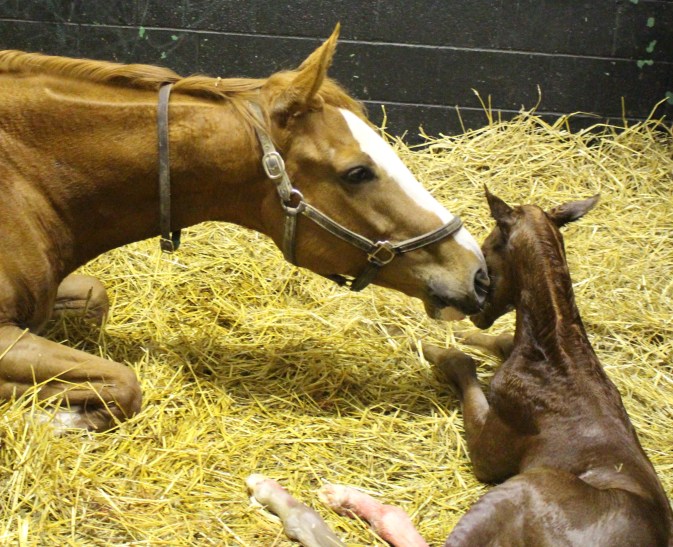
Hit Girl loving this new chapter
I can’t wait to see how this story goes. I hope it is filled with roses and daisies, mint juleps and champagne, pewter and gold. I hope to see this filly grow up and come streaming down the homestretch at Keeneland, just like her mother, as I scream myself hoarse. More importantly, I hope this story is long.
And if you see a little blonde woman on the rail, with tears streaming down her cheeks as a flashy chestnut walks by, don’t judge her. If you see her wringing her hands and biting her nails, seemingly frantic, don’t worry. And if you see her reach for her phone and pull up a photo of another chestnut with a big blaze and a strong hip to show you, entertain her.
Because she has read the first few chapters. She has helped write many of them. And now, even as an outsider looking in, she is simply trying to read the rest of this story, one chapter at a time.


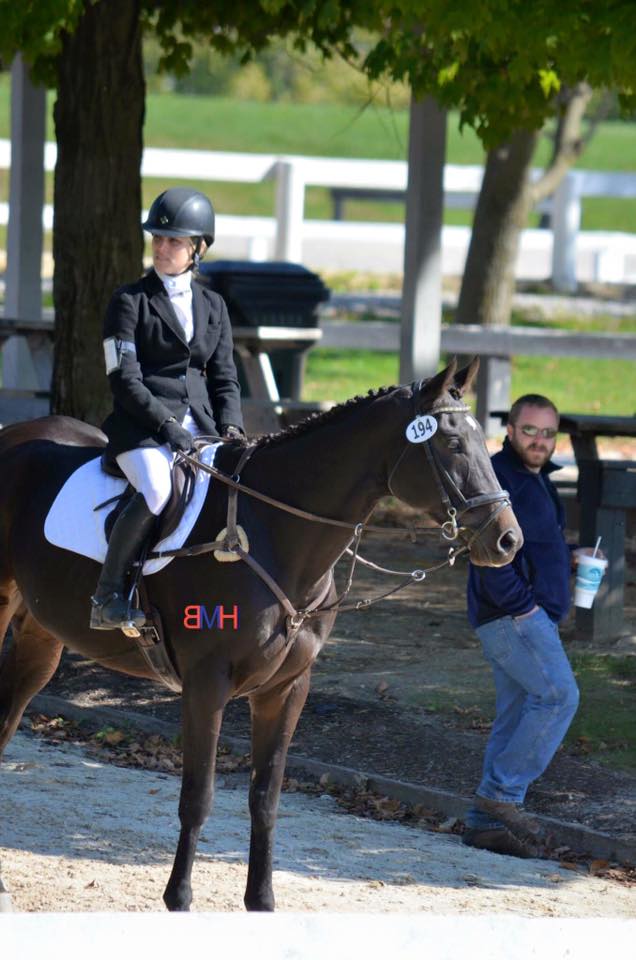
I can remember being 17 years old and sitting on my horse in the entrance to the arena in Harrisburg. It was 10 o’clock at night, and I was getting ready to go into my Working Hunter class…and I was petrified. I was staring off into the distance, as the course raced through my mind, and every worst case scenario played through my brain.
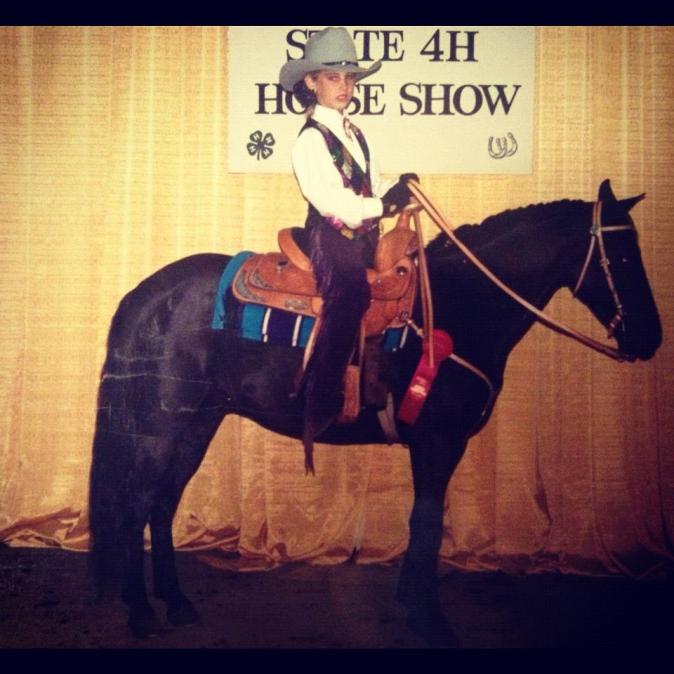
My petrified show face started young
Someone looked up at me and smiled, saying “Oh good. Carleigh is focused. We’re ready.”
But my best friend Amy took one look at me and panicked, knowing that if I wasn’t talking and laughing, if my face was frozen in what some may consider a look of determination, that in actuality, I was panicking. She quickly grabbed my calf and pulled my attention to her, attempting to distract me from the course that lied ahead and focus on her. She rambled on about new tack and cute boys, anything to get me to relax. Her mother, my trainer Rose, looked up at me and shook her head. She repeated, for the 100th time to my mother, that I needed a damned sports psychiatrist.
Because, even at the age of 17, it was obvious that I was my own worst enemy.
Flash forward 13 years, and nothing has changed. Today, I fell off. It wasn’t anyone’s fault, but if someone had to take the blame, I would carry the burden. I committed only half-assed to a fence, and my sidekick Mak just didn’t understand what was being asked of him. Being the amazing horse that he is, he tried to get through the question anyway, and ended up tripping due to lack of momentum – sending me flying. Like any good cowgirl who grew up with a terror of a pony, I tucked and rolled, and turned what could have been a bad fall into what many would consider a bump on the road. I got up, rolled my shoulders to check for breaks, dusted the gravel off of my sleeve, checked his boots, and remounted. To the outside, we were perfectly fine. But internally, I was reeling.
Because I am not like other people. I obsess over my flaws and fixate on my bad days. Thirteen years later after being self diagnosed with “sports psychosis,” I still am my own worst enemy. I am constantly told that I am better than I give myself credit for, that I am more CAPABLE that I feel, but moments like today constantly make me question my skill.
Because I don’t believe them. Am I good? If good riders are measured on their success, and success is dictated by lack of stops, rails, and falls, things that we all equate with “good” then no. I am not good. I hit rails. I let my horses stop. And although not often, once a year, I go and have myself a really good fall.

Mak is always trying to have my back
For someone who is the least OCD/Type-A/Perfectionist person in ANY other aspect of life, I am exactly the opposite with my horses. My sink might be full of dishes, but my horses buckets are scrubbed. My bed is unmade, but my horses stall is immaculate. I can’t remember to submit a manuscript on time, but my horses coggin’s are up to date. And I could trip and fall in front of a classroom full of students that I am teaching equine reproduction to and laugh, but if I fall off of my horse in competition, I am devastated.
I called Amy, the same friend that I attempted to distract me at the age of 17, and instead of allowing me to lament and obsess over my failure – she laughed. She laughed, and laughed, and laughed, and then started to cry a little bit, and then laughed some more. Once she was done laughing, she asked if Mak was ok. Once she knew that Mak was ok, she asked if I was too. Amy has known me my entire life. She knows my psychosis as well as I do. She also knows that I have probably been bucked off of more ponies than we can both count – she has witnessed most of these bronc rides.

Amy has been watching these moments of mental shut down for quite some time
But she laughs because she knows me, and has watched me cowgirl up time after time. And laughter was exactly what my ears needed to hear. She knew that due to my obsession with being perfect on these horses that I didn’t need to micro analyze every step that was taken. She knew that the one thing I needed was to be told that this wasn’t the end of the world. That this didn’t make me a bad rider. That this didn’t make me a bad horse mom. That all I needed was a hot bath, a bottle of wine, and a new day.
Because lets be honest, while we might see Buck win 3* after 3* on Reggie, if you dig deeper, he is also having some stops at Novice. And while Beezie is winning grand prix after grand prix, I have seen her come off in the 1.3m’s. And guess what? I’m going to just put it out there – Charlotte has probably had a horse pick up the wrong lead.
So what truly does make the difference between these great riders and the rest of us? It obviously isn’t being perfect. You read through the records, or go watch horse shows often enough, and it becomes obvious that they have their bad days just as often as I do. So that can’t be it.
So maybe the real difference between us and them is that they are able to push those flaw’s aside. They’re able to get off of that bad ride and swing a leg over the next horse without holding a grudge or feeling resentment. Each ride, each fence, each stride is a clean slate. And maybe, just maybe, they laugh. At their horses, at their students, at themselves.
Maybe that is the greatest lesson I could learn. I will probably always be my own worst enemy. I will always think that I am a crappier rider than I really am. But maybe the skill that I need to work on the most isn’t my paralyzed left arm, my chicken wings, or my swinging lower leg. Instead, maybe I just need to learn to laugh.
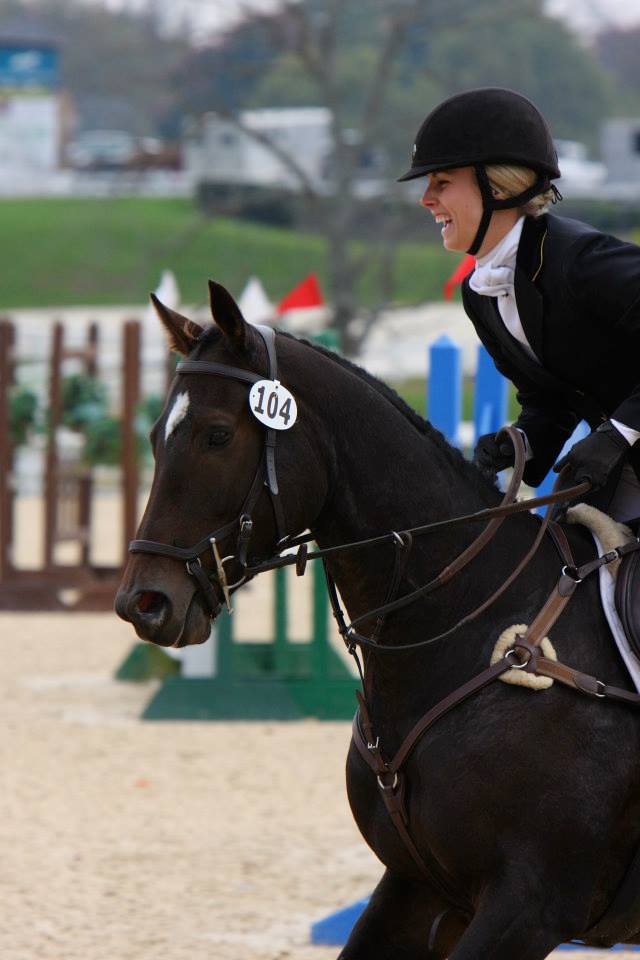
Learning to laugh.
I am entered in the 2016 Retired Racehorse Project’s Thoroughbred Makeover. And with this entry, I get to be in a Facebook group for the trainers. While entries were accepted only a few weeks ago, many trainers are already lamenting on their failures, their setbacks, and their soundness issues. And yet for every post about a failure, another trainer is posting a photo of their horse at its first horse show, or jumping its first XC fence.
And there begins the comments, or posts, about rushing horses, pushing them too hard, or overfacing them. It is a constant battle in our little equestrian community. Do we push horses too hard? Or do we not push them hard enough? Are you overfacing your horse? Or dawdling away with your time? While not the perfect scenario, there are now numerous competitions based on a time frame for the training scale. The RRP TB Makeover is just one.
And while all of these people are already panicking about their horses progress, I am sitting in Kentucky without a horse.
And yet I am not worried about this major flaw in my plan for the 2016 RRP TB Makeover. I am not new to this retraining, and I am not worried because I know how different each horse comes to the training table. I know that some might be ready to be showcased in the makeover after only a few weeks, while others may not be ready after years. I have retrained enough ex-racehorses to acknowledge this. And yet I will approach my horse shopping in the same manner that I always do. I will make sure that they are sound, of a certain frame and build and age, and pray to the Horse God’s that they have a good brain.
I am in the same spot that I was last year. With my one in/one out horse sales policy, I can never take on numerous mounts. Exactly a year ago, on March 14th, 2015, I had just sold my previous retraining project. I was in the exact same spot – while many trainers were already panicked about their progress, I didn’t even have a horse in my barn. But just like this year, I wasn’t concerned, acknowledging that the RRP TB Makeover is just another day in the year. Another day to showcase the ability and beauty of the thoroughbred. Something that I was already doing long before RRP, and something that I will continue to do long after.

The passion for the thoroughbred started young for me
And as I began surfing through photos of Mason, my previous sale horse, I began to realize just how well he and my current sales horse Called to Serve, or Nixon oppose each other. And just how much they describe my rule of thumb to let the horse dictate the ride. Not a friends Facebook page, not a fellow trainers show record. The horse.
I got Cold as Stone, or Mason (Dehere – A Song in A Minor ’10), at the end of August, 2014. He had been let down from the track and turned out for almost a year. He was sound and sturdy, with good feet, and a great brain.
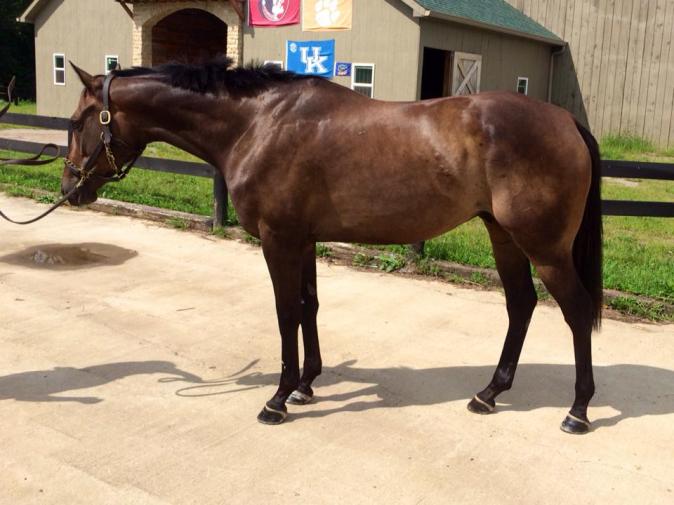
Cold as Stone or “Mason” the day I got him
Mason turned out to be quirky but honest. He was talented and true, but tended to overreact to many obstacles in his path. But he LOVED to jump. And because of this, and his extreme soundness, we let him jump. It kept his brain happy, it kept our rides happy, and in exchange, he was able to be introduced into the world of competition rather quickly. Within a month of retraining, he was at his first hunter pace, and within two months, he ran his first unrecognized Beginner Novice HT, where he finished on his dressage score of 34.
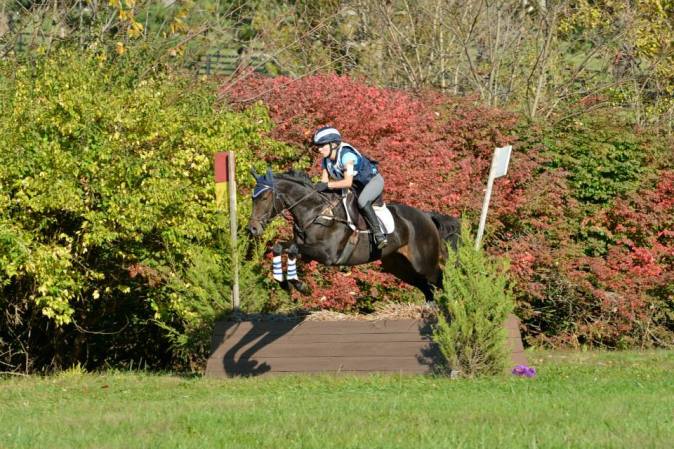
Octoberfest HT 2014, photos by XPress Photos
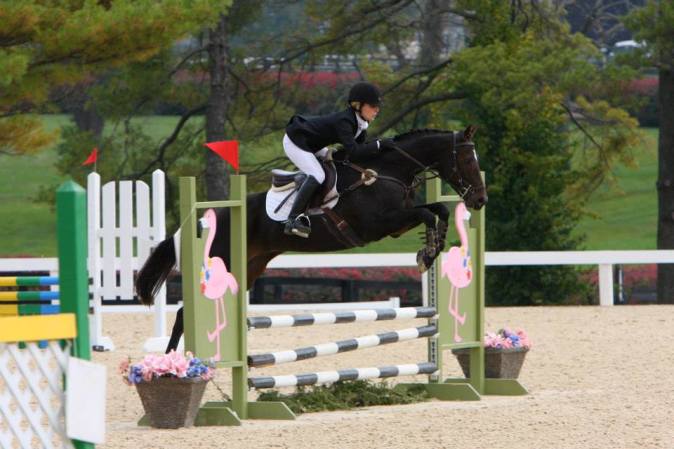
Mason dictated his speed in training, and we listened. He was naturally elegant in the dressage, brave and careful in the jumping, and took to eventing rather quickly.
But more importantly, he was let down, sound, and sane. I wasn’t fighting a tendon issue, or dealing with a horse crashing off of a high sugar diet while I was trying to teach him how to leg yield at the walk. He came to me ready for a new job, and took to this new job like a fish out of water. He is still bravely moving forward in his training with his new trainer, and this makes me so happy.
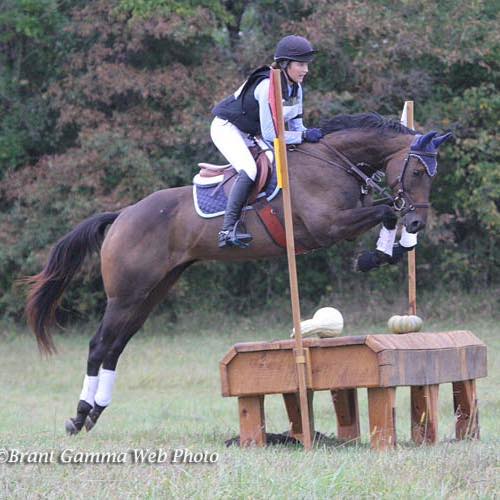
Mason and his new mom, Julia.
Flash forward two months later, and Called to Serve, or Nixon, was introduced to my life.
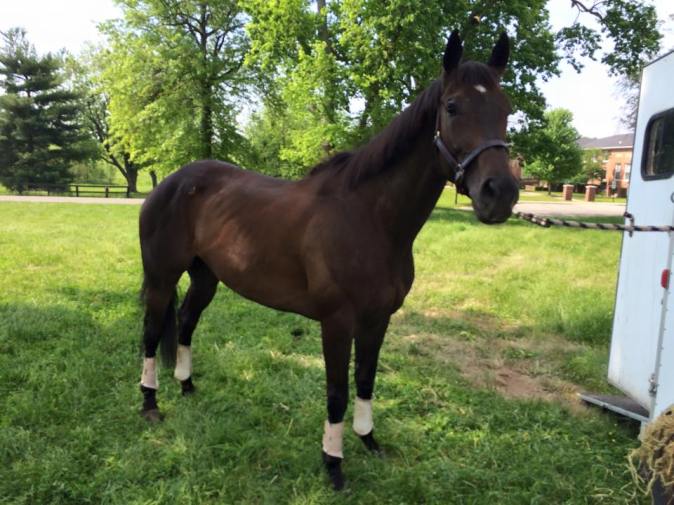
Nixon was last raced at the end of March 2015, and was let down for only two months. Like Mason, he also retired sound, but had had a much more lengthy and legitimate race career. Where Mason had only raced 9 times, Nixon had raced 24. Where Mason had stayed in the states of Ohio and Kentucky, Nixon had travelled the world. And where Mason had barely hit the board in Maiden Claimers, Nixon was a G1 placed, G3 winner of almost $500,000. Nixon did not like letdown. Nixon craved a job, and he was given to me at the end of May, 2015.
But unlike Mason, Nixon did not take to eventing like a fish out of water. I began my training in an almost identical fashion. Lots of hacking, lots of “little” obstacles, and lots of field trips. But where Mason took to jumping as if he had been doing it his entire life, Nixon took to it as a steeplechaser. The faster the better, and if that meant rails needed to be broken and his mom needed to pee her pants, well, so be it.
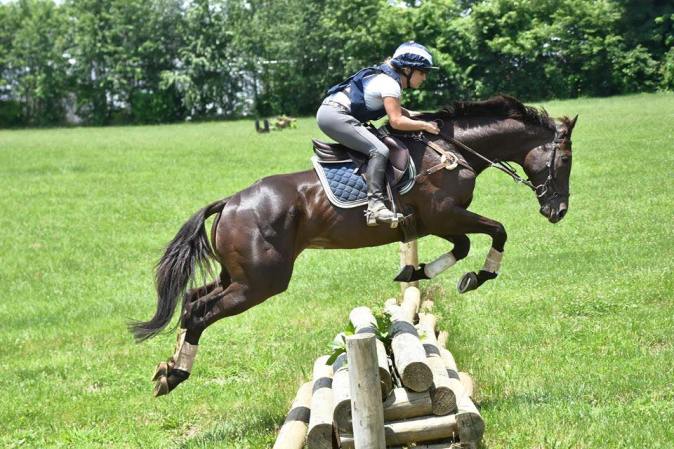
Bravery, and yet lack of technique. Photo by JJ Silliman
Because of this, instead of pushing forward, I pulled back. Although my heart and soul knew that he would eventually be a fantastic event horse, my brain told me that he wasn’t ready for it just yet. This was because of a combination of reasons – his brain, his speed, his heart. His athleticism was unregulated, having been allowed to get away with many bad habits at the track. And I don’t say this lightly, nor do I project this onto other racehorses. Mason had come to me with cadenced gaits and a students brain. But Nixon had come to me with a reputation. There are stories on ESPN and the Daily Racing Form telling of him taking off with world class jockeys. There are stories of him racing without his tongue tie or noseband simply because he said “no”. And these behaviors translated into our rides. He was boss, I was a minion.
So we regrouped. We went back to the sandbox, and began to work on things as simple as half halts. I wanted to be able to compress his gaits and obtain his attention. I wanted the rides to be a conversation, not a Donald Trump Political Rally.
And because of this, because of our “failures,” his dressage prowess became unheard of, and we all know where this landed us – straight into the winner’s circle of the 2015 RRP TB Makeover in the Dressage Discipline.
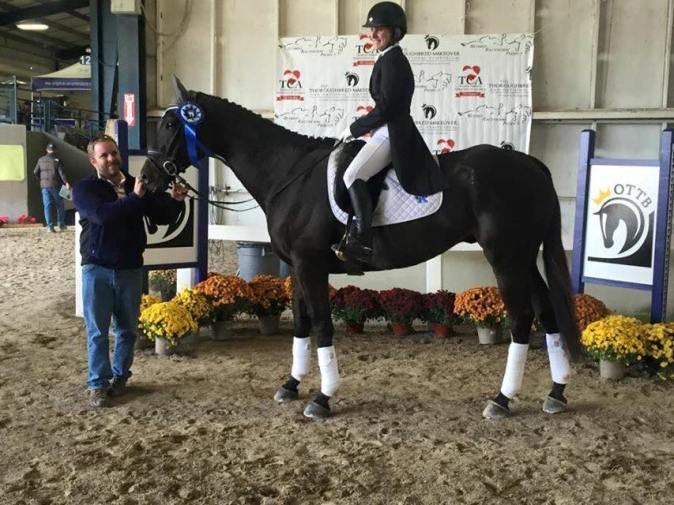
So this is where his training ended, right? With the RRP TB Makeover? No, of course not.
Because I knew all along that Nixon’s and my journey wasn’t completed by a single horse show. I also recognized that although he succeeded in dressage, I still believed he was meant for eventing. So after The Makeover, after we had built up his foundation on the flat, we went back to the drawing board in jumping.

Learning to respect fences…and me.
Nixon began making great strides in his jumping last fall, and this has carried over drastically through the winter and into this spring. He is now careful and scopey, brave but willing. And instead of dictating the ride, he asks me for help, which I willingly offer. Our rides are a democracy, not a dictatorship. And this makes me so happy.
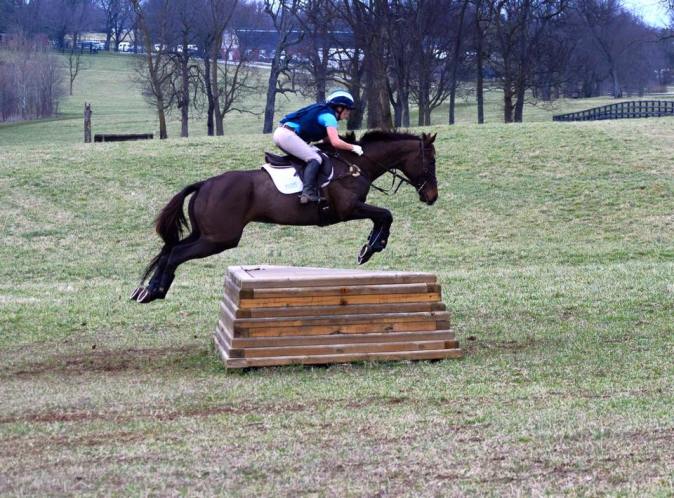
If you had asked me last summer how my training with him was going, I would have sighed and spoken of the failures and how we were moving backwards instead of forwards, so similar to how these Facebook posts read. I would have lamented on his difficulties, instead of acknowledging his abilities. He was already brave. He was already a beautiful mover. He was already sound.
All that I had to do was maintain those traits while building up his knowledge. While adding to his skill set. While entertaining his brain and introducing new concepts.
It might have taken longer than it did with Mason. It might have taken almost a year to get him to an event instead of a month. But does it matter? No. And why, you might ask? Because I know that both of them eventually reached the same place. They are both competent, skilled, beautiful horses. There are no holes in their training, there are no major flaws in their soundness. They both got to that place via different routes, but both routes brought them there.
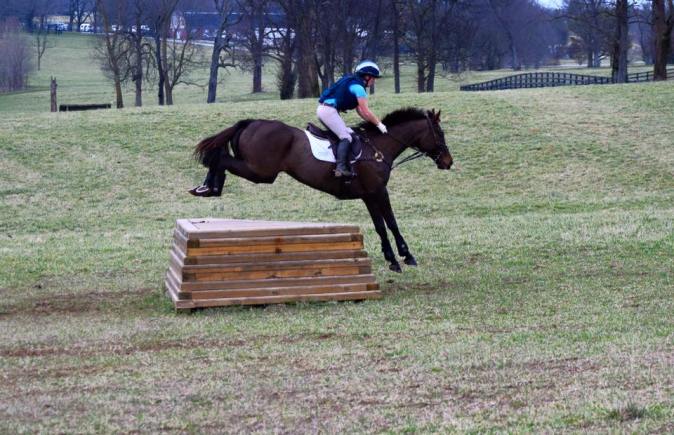
That is what it means to be a good trainer. A good trainer doesn’t put a horse in a box. A good trainer doesn’t just succeed with a single type of horse. A good trainer finds the horses strengths and utilizes them to rebuild their weaknesses. They take their time. But time is relevant. Time can mean one minute, or one life.
Let the horse be the clock. Let the horse turn the hands. It might feel like you are moving in slow motion, but the dials will still turn. And while it feels like you are moving backwards, you are not. Because lets be honest, we really can only move in one direction: forward. So keep going. One foot in front of the other. Some of us might be walking, some of us might be running, and some of us might be like Nixon – galloping straight through life. But we’ll all get to the finish line, I can promise you of this.
The Retired Racehorse Project released their list of trainers which they feel make this years Thoroughbred Makeover exciting, and as the winner of one of the disciplines from last year, I was number one on the list for dressage. My bio read like this…
2015 Thoroughbred Makeover Dressage Division Winner on Called To Serve. Carleigh is an amateur who has enjoyed training and selling off-track Thoroughbreds when not studying for her doctorate in equine reproduction. She has deep roots in eventing, ranch work, and Thoroughbred racing.
Ranch work. Eventing. Racing. Sounds like the pedigree of an accomplished dressage rider, right? Underneath me, there were five Grand Prix rider’s listed. The highest scoring rider on Centerline Scores. The champion of a USDF class. A women who trains horses for The Queen, and no, I don’t mean Beyonce.
I laughed at first, and then fell into an almost comical funk. Because I am a competitive person, an over achieving person, I am generally hard on myself. I am turning 30 in two weeks, and have accomplished almost none of the goals that I set out for myself at the age of 5 when I began competing.
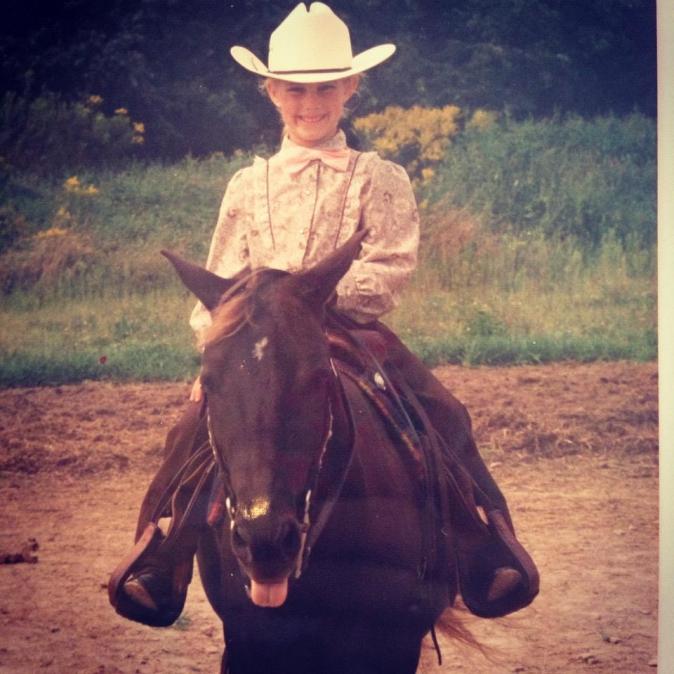
I had big goals
I have not gone to the Olympics. I have not ridden around Rolex. I did not get my A in Pony Club. I did not win the Maclay’s. I have not jockeyed a horse to the Kentucky Derby. I do not own my own boarding facility. I am not even a professional rider.
I was lamenting over this with my friend Alexa last week as she rode my “champion” horse, Called To Serve. I was hacking my newest ex-racehorse, Marilyn’s Guy, and giggling as he finally accepted pressure on the bit, learned to trot a pole, and steered around her indoor arena as if he had been doing this his entire life. And as I trotted a large 40m circle, I watched as she put Nixon through shoulder in, haunches in, leg yields, and beautiful transitions. I realized that I had come full circle, yet again, with my training horses. One was moving off into adult-land, just as another baby began his transition. And this made me so happy.
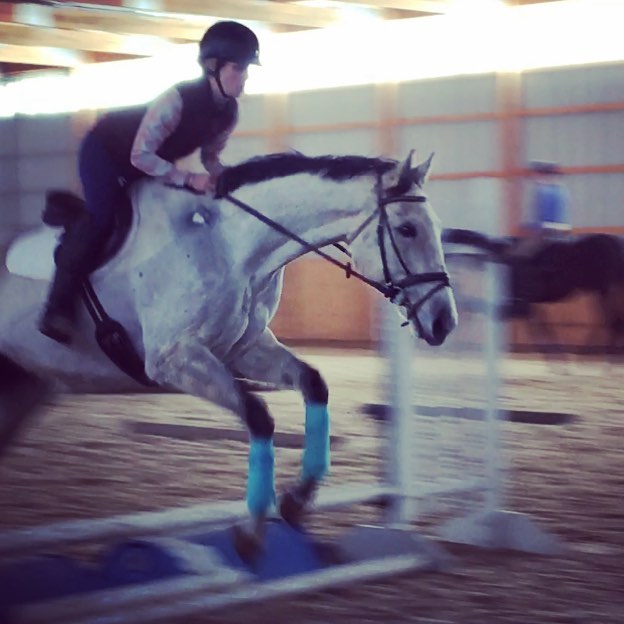
Kennedy, the horse formerly known as Larry, learning how to jump.
But Alexa spoke of how she wanted to get back into the upper levels of eventing, as she was in her own personal funk after being highly successful as a Young Rider. And as she lamented over her own personal failures, I stared slack-jawed, wondering how someone so young and, what I considered, so successful, could be so hard on herself. She was living my dream. She had the medals, she had the farm, and she had the experience up through the FEI levels, and she was only 21. She had spent the entire summer jumping fences that make me poop my pants, and training with the elite. All I had was a few good, solid, fun, young thoroughbreds, and a resume that no one understood. But while Alexa and my resumes were so different, we were so similar. We both wanted greatness. We both wanted that to be with horses.
But then something dawned on me. Maybe I wasn’t made to be an upper level rider. Maybe I was not created to steer a horse around Rolex. Maybe, just maybe, my role as a horseman was in something entirely different, and entirely necessary. Maybe I was put on this earth to get these horses ready for those riders. Maybe my career will be made on breaking, training, and retraining horses.
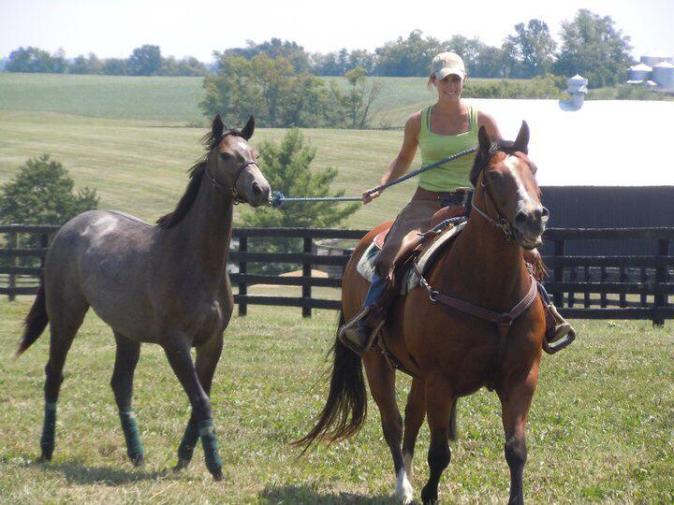
I said this out loud to Alexa, and she reminded me that this is something that is SO necessary in the industry. That this is what we are lacking in America. We have the upper level riders. We have the big name competitors. But we are lacking the people who can instill SOLID basics on young horses. We are lacking the breeders. We are lacking the starters. We are lacking the people who can take a horse and find their secret skill, and bring that to light, all the while not creating bad habits, fear, and tension.
And maybe the Alexa’s of this world are made for fame, and glory, and medals. And the Carleigh’s of the world are made for first crossrails, first beginner novices, and first cross country schools. And these two people can, and need to, coexist for America to get back on the National stage. We need the Carleigh to be standing at the finish line of Rolex smiling, as the Alexa finishes a double clear on the horse that Carleigh took his first beginner novice.
I hope Called to Serve gets to experience just that, and I can promise you, I will be sobbing with tears of happiness as he does.


I don’t know if RRP should have listed me on the trainer list for the dressage discipline, because I don’t even know if I will compete in dressage this year. I won the dressage last year not because of any championship I had ever won, or high score I have ever received. I have no medals, I have no diploma.
But what I did have was an amazing horse. I had the patience to unlock that horses talents. And I had the training, methodology, and ability to blossom him into a phenomenal dressage horse. None of my previous ex-racehorses would have won the dressage, but one of them might have won the eventing. One of them might have won the jumpers. And Dynamaker, my true love, would have probably won the hunters – even if I was adorned in my monoflap and scrambling for a pair of tan breeches.
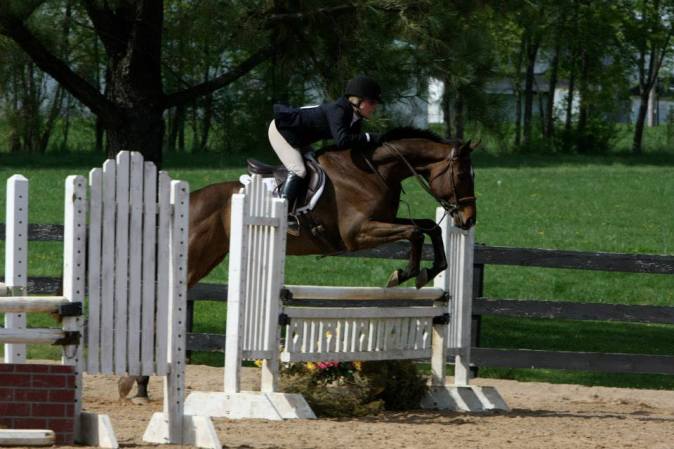
My training level event horse REALLY wants to be a 3′ hunter, even in my monoflap.
And maybe, just maybe, this is what I will keep doing. I think there is truly a void there within our horse industry. A void of people that have experience in a wide variety of disciplines, but who acknowledge that a good horse should be brought along in a similar manner no matter what the end goal is. And a good trainer can bring along that horse. No matter what discipline. No matter what age. No matter how many races won or how many rides have been put on. I want to be that person, even if my pedigree doesn’t read as amazing as the rest. Let them scratch their heads as they read Ranch Worker. Eventer. Pony Club Drop Out. Dressage Queen. Racing Enthusiast.


Those things are a lot more similar than you thing. They have all taught me different aspects of the rider that I am today. And all of those them have one thing in particular in common. A good horse – and a trainer who didn’t ruin the good.
How do you measure a horses life?
Is it in competitions won? Purses earned? Ribbon’s hanging? Or live’s touched?
I surround myself with some pretty phenomenal horsemen and women. Living in Lexington, Kentucky, I get to be with the best of the best. The best breeders, the best veterinarians, the best blacksmiths, and the best staff.
We spend our days, our nights, our lives caring for animals. Only to us, these animals are not just entities. They are so much more. They are our bread and butter, our stock market, our friends, and after 100-hour weeks, missed weddings, lack of sleep, and lack of relationships, they become our families.
Our days are consumed by what most assume are trivial activities – fixing a fence, mucking a stall, repairing a tractor. It is such a strange life to the outside. Words like meconium, hippomane, breast collar, and batwing are normal dinner conversation – if we can actually get off the farm to interact with others. Beers are gulped as the foaling season is discussed.
And as the beers go down, we begin to discuss the great’s. Of course there is always the one person at the table who gets to declare that they foaled John Henry, or that they once galloped Game on Dude. The person who gets to say they were there the day that Affirmed won the Triple Crown, or led The Green Monkey to the ring.
But normally, the horses that consume our dreams and haunt our conversations are horses who’s names that many may not have ever heard. Broodmares who provided us our first “big sale” – even if it was only $25,000. Fillies that we brought into the world who may not have won the Oaks, but put food on our table’s as breeders. Colt’s who didn’t hit their stride until their four year old year. Who may not be millionaires, but who hit the board Every. Damn. Time. I have these horses. Horses like Hazard’s of Love, and Hit Girl, and even Firehouse Red. You might not have heard of them, but they are mine. They are the one’s who’s stories I get to relish with friends over a beer.
We lost one of those hidden great’s last week. A mare whom many of us young bucks wouldn’t remember, whose name does not adorn a street sign in Lexington, Kentucky. A mare who ran in TWENTY TWO stakes races, three G1’s, and won over $600,000. A mare who won the G1 Ballerina Stakes at Saratoga, who won 14 of her 34 starts, and hit the board in another seven. These are the fact’s that we as an industry regurgitate to the outside. But to the insiders, the old boy’s club of the Thoroughbred Industry, the people who will never be interviewed on Derby Day or analyzed on The Today Show, she was so much more.
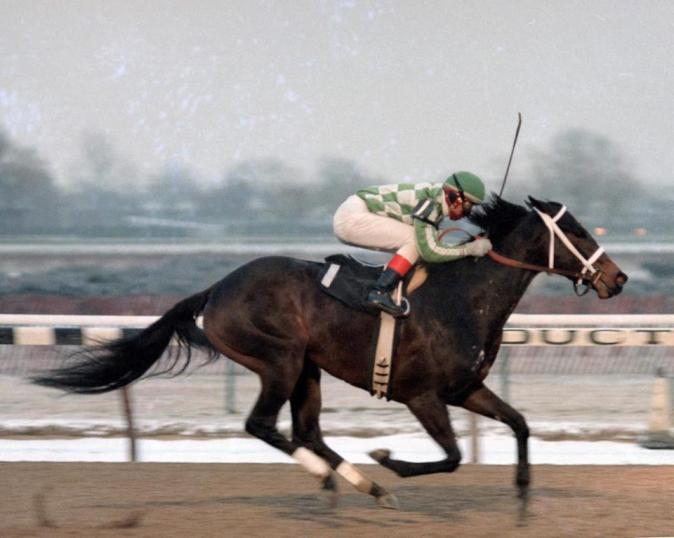
Feel the Beat galloping strong. Photo by Bob Coglianese.
Feel the Beat left us last week, with those who knew her best surrounding her. She might have not adorned the winner’s circle in 27 years, she might not have produced a foal in ten, but she was regarded with extreme respect, and extreme love. Immediately after she was put down at the age of 31, the daughter-in-law of her owner messaged me. Questioning why it is that we never hear of these stories? Why is everything published about “us”, the “we” of the thoroughbred breeder’s negative? Or if it isn’t negative, it is about a Derby winner, a sale’s topper, a millionaire. It is never the other’s.
These mares, like Feel the Beat, are the true superstars of our industry. These warhorses, who pass on their heart, their endurance, and their legacy onto others. Their lives deserve the same level of respect, the same fanfare of a farewell when they leave us. But they don’t. They simply slip away, acknowledged and grieved by only those who knew them in their last few years, and nothing else.
Pennland Farms did not have to buy this mare for $1,200 at the Fasig sale in 2005. She was 20 years old, she was barren, and she would not reproduce for them. They did not get her for some get-rich scheme. To a financial advisor, this probably wasn’t the most intelligent money spent. This was a smaller operation, one that relied on their horses producing strong, healthy foals. But the owner of Pennland Farm wasn’t investing in his own future, instead, he was securing her’s.
This mare, Feel the Beat, had done for his family and his farm, more than enough. He had owned her sister Whitebread, as well as Whitebread’s daughters. These horses had paid for the mortgage, the feed, the bills. And while it is assumed that these horses are viewed as entities, for him it was different.
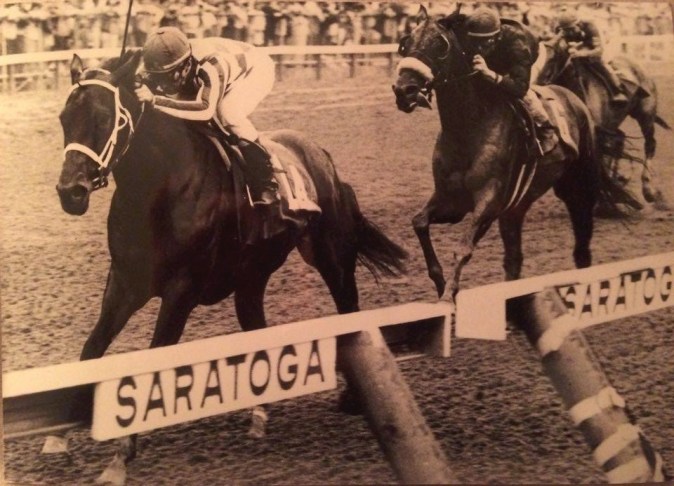
Feel the Beat winning the G1 Ballerina S. Photo by Bob Coglianese.
So, for $1,200 he secured this great racemare. For $1,200 that could have been spent on new fencing, or a transmission for the farm truck, he brought what many would view as a “useless” mare, and put her in a field on his farm. For eleven years, she has been turned out with her two girlfriends and a donkey, living the life of ease. A retirement suited to the greatness she once was. An ode to the spreading effect she had had for him, and his family.

Feel the Beat in retirement at Pennland Farms.
There was no parade last week. There was no fancy cemetery surrounded by monuments and pillars. No one at The Bloodhorse wrote a great eulogy. Instead she was laid to rest next to her two best friends who had already left this earth, in a peaceful passing of old age and lack of pain. She was surrounded by this man and his family, who acknowledged what she had done for them. A farm which took care of it’s own, no matter how far related, no matter the cost. She touched their lives, just as I know they touched hers.
So here is your eulogy girl:
Rest in Peace, Feel the Beat. May we be reminded of the brilliant racehorse that you once were. May we acknowledge the family that you produced, and the line’s that are stronger because of you. May you run swiftly again. May you be free of aging pain, and free of lingering doubt of if you were great. If greatness is measured not by one’s worth or objects acquired, but by the number of lives they affected, then you were great. You ARE great.
RIP Feel the Beat. Run swift, run strong, run free.
“The path to becoming a successful rider is in riding every horse. Every single horse that you are offered. This is the simplest way to bettering yourself.”
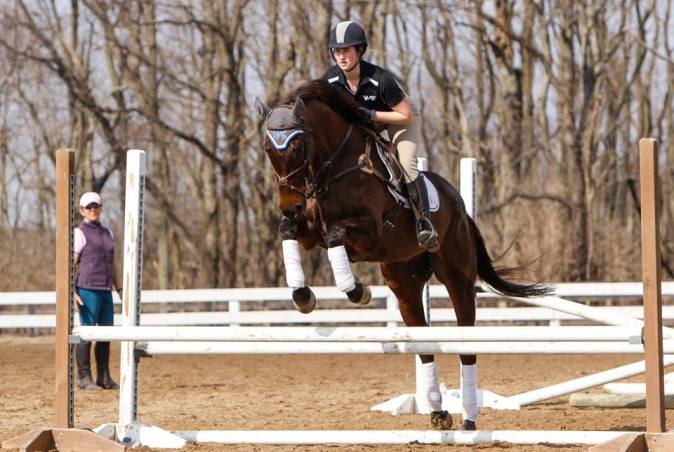
Alexa and Nixon through a grid. Photo credit Taylor Pence
We have all read a status similar to this on Denny Emerson’s Facebook page. I know I have. Every time I read them, I am forced to reassess my goals, my strategy, and my game plan. I am one of those people who craves riding horses. Tricky horses, easy horses, big horses, little horses, dressage horses, jumping horses, they are all desired by me.
So it came as no surprise to anyone when I posted on my own Facebook page that I had been coerced into catch riding a new horse in a clinic.
Back track — I now currently have three horses. Mak, or my “big horse,” is just now coming out of winter vacation, Nixon, my Retired Racehorse Project Thoroughbred Makeover horse is trucking along in his training to become a (hopefully upper level) eventer, and Kennedy is a newly off the track project who has had approximately 5 rides. These three horses entertain me, fill my days with smiles, teach me how to be a better rider, and at the end of the day, they drain my bank account.
So when I saw that world renowned instructor Mary D’Arcy was coming to town to teach a clinic, I checked my bank account, shook my head, and closed the invitation. I knew I couldn’t afford a clinic right now. I sent a text message to the woman hosting the event, and painfully explained to her that I would not be able to ride. I half jokingly told her that she should just take my horse, and instead of laughing, she responded “really? Can I?”
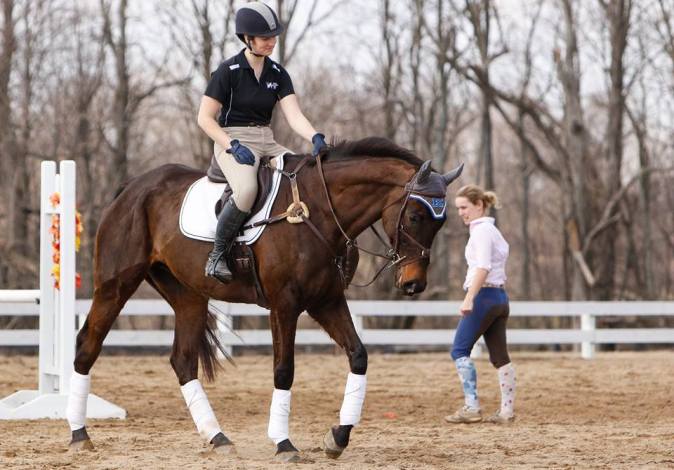
Getting to play owner instead of rider for once. Photo credit Taylor Pence.
And I agreed. I knew that Alexa was a fabulous rider, she has ridden Nixon a handful of times, and they click so well. He is just as smitten with her as she is with him. And that is not common. Nixon needs a solid rider, but with a soft hand. A brave soul, but with a calm heart. He is extremely athletic, but like most of the great’s, he is tricky.
So I hauled him to her farm on Friday to let her brush the cobweb’s off of their partnership, and as they hacked around, she mentioned to me that she had this pony. This amazing little pistol of a pony who needed sold. But she was having a hard time even getting training rides on it, as the pony was 13.2hh, and Alexa was 5’8. I laughed at her and said that I would ride the pony. Any time. Any day. My 5’3 little person status might as well be used for something good, right?
And that is how I got entered in the Mary D’Arcy clinic on a *horse* I had never ridden.
Alexa offered to give me a spot, and what was supposed to be a simple weekend of hauling a horse to and from a clinic quickly became a Pony Club rating on crack. Alexa would be riding 17.1hh Nixon, having ridden him probably 5 times in the last 6 months, and I would be riding Polly the Pony, sticking at 13.1 1/2 hh, a pony I had never ridden.
But, true to her reputation, the weekend went beautifully. Mary is an amazing clinician. From the Beginner Novice group to Intermediate, she was full of words of wisdom and homework. The ability to truly assess a rider and horse duo due to her simplistic tools and longer sessions made the clinic feel like private lessons. The sessions were made up of smaller groups, with a full hour devoted to dressage, followed by an hour of grid work. The second day was coursework, and everyone walked out of the indoor today begging for Mary to return.
There was no overfacing of young horses, as the courses and gymnastics started extremely small and were built up. Mary was tough but fair in assessing each individual riders weaknesses, and not only assessing them, but addressing them. I learned in just 3 hours of riding on a horse I had never seen before that I tilt my upper body down before a fence. Something that I get away with on a 17hh horse, but something that becomes quite costly on a pony who still has a stride left before take-off. Each rider left feeling reflective, contemplative, emboldened, and excited for the homework that lie ahead. And that is exactly how I hope all clinics would end.
Nixon was fabulous for Alexa, letting me know that I have finally created a horse that is not only beautiful, but rideable, and that makes me so happy. I want him to be at a place where ANYONE can ride him. We have him there on the flat, and he is getting there over fences.
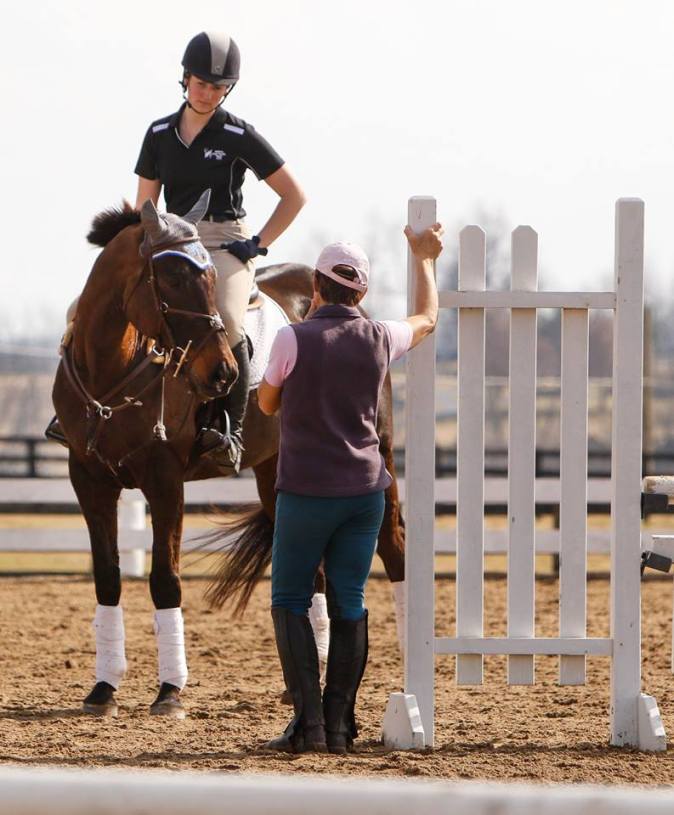
Mary sharing her words of wisdom. Photo credit Taylor Pence.
And me? Well I have a new lover. Her name is Polly. I can’t believe I’m admitting to loving a mare, nonetheless a chestnut mare, but this creature, this mythical being of shorthood, was just amazing. She rode like a Dutch Warmblood that had spent too much time in the dryer. Soft in the aids, able to skip down a line, and brave as can be, I couldn’t remove the smile from my face. She is for sale, and it was so tempting to just trade my 17.1hh Nixon for this little dirt bike. I could have my own personal Teddy O’Connor, only 6 inches shorter. Our colors would be pink and silver, and it would be fabulous!


I learned so much this weekend. I learned that Nixon, my sales horse/project/future Rolex winner is exactly that. My adoration for him was reaffirmed by Mary, Alexa, and everyone who watched him. I learned that I will ride with Mary if and when she ever returns to Lexington, as she is now a member of my rather short list of clinicians that are worth every penny of the time and money that is spent on them. And I learned that Mr. Emerson might be onto something. Maybe the best thing for you really is riding as many horses as you are able to, especially with eyes on the ground like Mary’s. Maybe we all should live a little bit outside of our comfort zone. Maybe the best thing for all of us would do a little horse swap, a la Pony Club rating style.
And maybe, just maybe, the biggest lessons that are learned are found in the tiniest of packages. Polly taught me this, and for that, I am forever grateful.
I remember the foreman of a ranch sitting next to me, patting my knee, and teaching me one of the most important lessons of life:
“You work your workhorse the hardest.”
I had asked to meet with him to talk of my position on the ranch, befuddled at the fact that I was asked to do more than many of the other staff. Not understanding why I was on the list to jingle 5 days a week when others were only there at 4:30am twice a week. I was burnt out, I was exhausted, and at the age of 20, I was ready for a grade A temper tantrum. But these words resonated with me.
Because in Wyoming, we truly did have workhorses. We were given a string of 5-6 horses to work with. Some of these horses were young stock, needing broke and trained. Some of them were older horses with bad habits, making them unable to be ridden by the guests who came to the ranch. And then some of them were just too NICE to be handed off. These were our workhorses. The horses we rode the most often. The horses we roped off of. The horses that we trusted to pack us on 20 mile rides without a hitch. And because they were the hardest working, they were worked the hardest.

Using horses for work, not sport.
I had one of those horses. His name was Headley. I remember seeing him for the first time, and having the heart of a thoroughbred lover, I felt it flutter. He wasn’t much to look at. Approximately 16.2hh, with a tail that had been chewed off – he was about 200 pounds underweight. But his head was just beautiful. I remember locking eyes with him and seeing the soul of a breed that I was raised to love – the thoroughbred.

The prettiest face in the corral
He had the same natural fear of the world as Levi. Only Levi was comfortably tucked in a stall of a premier jumper barn, shod all the way around and blanketed, and Headley was standing in a corral in the Big Horns, underweight and unsure. And in addition to this, he was petrified of men. On him, around him, from a distance, Headley would tremble in terror every time a man came near. And if they came closer, or tried to swing on, Headley did everything in his power to escape. Halters were broken, and cowboy’s were tossed. And in exchange, Headley became quite unappreciated. In fact, he was hated.
But he loved me. So I gave him a chance. Because in ranch life, these antic’s are not only unappreciated – they are unallowed. Horses must behave in a specific manner. They are here for a purpose – whether it be for the guests to safely ride them, to be roped off of, to pull the hay wagon, or to be used in rodeo. And if they did not fit those purposes, they were unusable. An unusable horse, is simply that – not used.

Headley moving cattle by himself
I learned quickly that although Headley was so frought with terror at other things, he shined in others. He was calm and happy on the trail -as long as I was the one riding. He stood patiently for gates to be opened and cinches to be checked. He was easy to groom, to tack, and to mount.
And, he was FAST.
I learned quickly that just as his head screamed thoroughbred, so did his legs. He could carry me at speeds that I had never experienced, and I quickly passed this bit of information on to the other wranglers at the ranch. But I was that little girl from the east coast. I wasn’t even a real cowgirl. I didn’t know anything. So just like most men, they didn’t believe me, and duals were challenged.


We would meet behind the corals, and line up. They would always be on their fastest mount – usually with a story of how this horse used to be a chuckwagon mount or came off of the track, and a cocky grin. I would gather my reins and get into two point, someone would count down, and we would be OFF.
And EVERY SINGLE TIME Headley WON. The cowboys would stare off at us with disbelief as dirt was kicked into their faces, and Headley’s short tail and tall haunches would disappear into a cloud of dust in front of them.
Disbelief soon became comraderie, and it was thought that maybe, just maybe, we had the fastest horses in the county. So Headley (and I) were entered in the annual rodeo held downtown at the Buffalo Fairgrounds in the quarter mile race. I remember being petrified of riding in front of that large of a crowd. What if I fell off? What if he wasn’t really that fast? What if we were a poor representation of the ranch? Headley wasn’t a quarter horse, he was a thoroughbred. And I wasn’t a real cowgirl – just a pony clubbing-eventer playing dress up in a pair of Cruel Girl’s. I didn’t belong here, and neither did Headley.

Headley and I FLYING at the rodeo
But I didn’t have anything to worry about. Headley loaded, tacked up, warmed up, and ran like a pro. We didn’t win that day, but placed second. Enough to earn a roaring applause, and two hundred bucks.
But more importantly, Headley earned the recognition that he deserved. He earned the title of work horse. He found his purpose. He was cherished by the ranch as a horse who deserved a place in the corral. And as we walked back to the stock trailers, he was met with pat’s on the neck, and praise. And for the first time, he didn’t tremble. He didn’t run. He basked in the praise with his ears pricked and his eyes proud.

Headley finally letting men near him – even if it was just my dad.
Headley found a purpose that summer. He became a work horse. He became useful.
I wish every day that I had brought that horse home with me. I was able to keep track of him for a few more years through friends who continued to work for the ranch, and then the updates slowly faded alongside our communication. Time passed, and things changed.

But Headley taught me so much those two summers. He taught me patience, he taught me strength. He taught me trust. And he taught me to find the good in everyone, in everything. To realize that we all have our specialties. And most importantly, he taught me that being the work horse is a good thing. It might mean longer hours, strenuous labor, and lack of sleep. But more importantly, it means you have a purpose. A role. A place in this world.

Headley found his place, while also teaching me mine. He taught me how to work with young stock. How to find their hidden potential. How to calm a skittish horse. And how, at the end of the day, sometimes all you need to do is to let them run. I use these skills every time that I get a horse off of the track. I use them every time I swing on a young horse. Headley might have been my first retraining experience with an ex-racehorse. And he taught me the most valuable lesson. That sometimes you just need to let go. Grab mane, hold on tight, and find purpose in the exact thing that these horses were bred to do. Gallop.
 A Yankee in Paris
Recent Comments